Editor’s pick — Accessory quick take: key highlight (movement/specs for watches, materials/finish, limited run, pricing tier) in 1–2 lines.

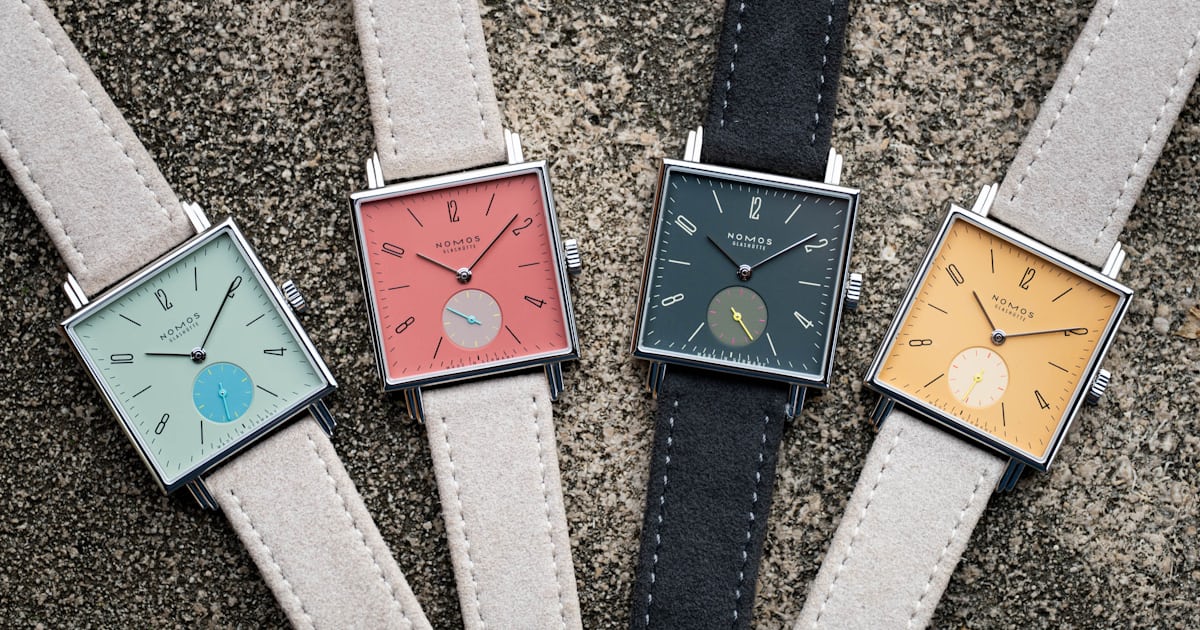
Nomos is never one to stray from color. But even though leaning into “colorful” can often be a one-trick pony in the industry, I’ve always loved how they handle their dials and the diversity not just in color, but in saturation, texture, and contrast. After a few major releases where bright, funky colors have stood out, the brand dials it back a bit for a series of four Tetra models that feel unique in their own right.

They are the Ochra, Terra, Salvia, and Basalt references, and together they form the Tetra Origins collection that feels just as playful as watches we’ve seen come before it, yet with a bit more subtlety in a more desaturated spin. To me, the Tetra often feels like the odd duck in the lineup. Obviously, the square-shaped case and Art Deco-inspired lugs are the brand’s most unique (or, alternatively, polarizing) design details. But at the same time, it’s a line that gets rarely updated and offers very few options to begin with. So when I saw these four versions a few months ago, back in Glashütte, it felt like a nice breath of fresh air.
Now, to the specifics of each colorway, which the brand cites as inspired by nature. Ochre is inspired by the warm golden pigments of ancient Egyptian craft, while Terra evokes earthiness through its pale brick-red hue. The muted green of Salvia reminds me of moss, while Basalt’s black dial evokes the eponymous volcanic rock. But what makes these dials so Nomos is the unconventional splash of color added to the small seconds subdial. On Ochre, the seconds marks are printed in a bright red, with the seconds hand itself a bright yellow behind a beige background. The red Terra hue gets a contrasting subdial of faint lavender, with yellow seconds marks and a vivid blue seconds hand. Perhaps Salvia feels the most conventional, with a blue subdial, yellow marks, and a light blue seconds hand. Finally, a stoic Basalt dial gets a bright punch of fuchsia seconds marks and a yellow seconds hand over a grey subdial.


These Tetras remain mid-sized, at 29.5mm in “diameter” and a 40.5mm lug-to-lug for the steel cases. Manually wound, they stay quite thin at 6.5mm in case height, thanks to the DUW 4001 caliber beating inside. It’s a small but appropriate movement for the case, filling out the exhibition caseback and showing off the striping and blued screw. While the movement is built in-house, the architecture is based on Nomos’ older Alpha interpretation of the Peseux 7001, and the DUW-ification brings significant upgrades, including Nomos’ proprietary Swing System escapement. Water resistance is rated to 5 ATM, which the brand calls “splash-proof.”
On the wrist, the Tetras wear wonderfully for those with smaller wrists (including yours truly). I find square watches tend to wear larger than the equivalent round design, so what seems like a downright tiny 29.5mm in diameter punches up in reality and feels more like a 35-36mm watch in real life. If you have a large wrist, the Tetra might not be for you, but the square case shape manages to give a wrist presence far more imposing than its specs would suggest. Though I don’t think I found this an issue with Nomos’ more vivid colorways, I will admit that the muted colors on these four references need to be tried on in person, as the effect of these dials actually depends quite a lot on your skin tone. Ochre might be the biggest example of this, with the pale yellow not often seen in other watches.


While I would have always thought that the green of the Salvia would have been my favorite, the black Basalt execution stole my heart. I think it’s down to the fact that the Basalt is the most versatile of the four, yet manages to evoke the most playfulness in the contrast between the dark dial and the bright subdial accents.
All four are certainly fun executions, but Basalt gets away with it so much more sneakily. I don’t really own many shaped watches in my collection, but I’ve long had an affinity for the Tetra, so it’s nice to see these as part of a non-limited series. But Nomos — bring back the Tetra with power reserve indicator, pretty please?
For more, visit Nomos.
Source: www.hodinkee.com — original article published 2025-11-17 14:00:00.
Read the full story on www.hodinkee.com → [source_url]