Editor’s pick — Accessory quick take: key highlight (movement/specs for watches, materials/finish, limited run, pricing tier) in 1–2 lines.

Leaving the keynote of this September’s Apple Watch and iPhone launch in Cupertino, I had one thing that I could not wait to ask the Apple Watch team about. As a watch guy, there was one thing that was ever-so-briefly mentioned that stood out to me—the fact that all of the new Series 11 and Ultra 3 cases were 3D printed out of 100% recycled titanium. Apple presents it as a key part of its sustainability efforts, aligning with its 2030 carbon-neutral goal and its push to maximize recycled materials. The process feels very technically unprecedented at this scale, and we got an exclusive chance to sit down with some of the folks at Apple to learn how this all comes together.


Photos by TanTan Wang

As I noted in my hands-on with the latest generation of watches, what struck me from the moment the switch to 3D printing was announced was that it was all about achieving a literally identical aesthetic to the Apple Watches of the past. This approach contrasts with what I’ve seen in traditional watchmaking, where metal 3D printing is typically used only to achieve visually striking results that a 5-axis CNC machine cannot.
Previously, making a case for an Apple Watch would have felt very familiar to anyone who has stepped foot in a Swiss case supplier or a manufacturer making their cases in-house with rows of CNC machines. It’s subtractive manufacturing, which means starting with a forged metal blank and then milling away material until the desired shape is achieved. This results in a significant amount of machining time, as well as a substantial amount of leftover material in the process.

However, 3D printing is additive, which means that as you create a case layer by layer, you use significantly less material and energy to form the final result. As a kid who grew up watching the show How It’s Made, I was eager to understand how Apple managed to scale this process without compromising on quality.
Luckily, I got an opportunity to sit down with two of the folks spearheading the multi-year endeavor for Apple’s new manufacturing process: Kate Bergeron, VP of Hardware Engineering, and Sarah Chandler, VP of Environment and Supply Chain Innovation, as they gave me a peek behind the scenes.
The Process
From a high level, Apple’s titanium cases are 3D-printed using the well-established Laser Powder Bed Fusion process. If your only exposure to 3D-printing is the machine at home that heats up plastic filament through a nozzle, you’ll find that the process for Laser Powder Bed Fusion is quite different.

The process involves over 900 layers over the course of a 20-hour print, then final machining and finishing steps.
First, you start with 100% recycled titanium, which is then atomized into a fine powder. For the 3D-printing process, a lower oxygen content, such as that found in grade 23 titanium, is crucial, as powdered titanium can become highly explosive when exposed to the heat from the sintering lasers.
Many of us might be familiar with the grade 5 titanium alloy found in watches (with 6% aluminum and 4% vanadium in the mix). Grade 23 titanium features the same composition but offers a lower oxygen content, along with a few other minor differences. Its use is not unheard of in the watch industry, as Blancpain offers its titanium watches with grade 23 cases, and microbrand Laventure released the Marine Type 3 Chronometer this year with a grade 23 case as well.
Procuring grade 23 titanium, especially when it is 100% recycled, is not exactly straightforward, as the recycled metal must be sourced from multiple external suppliers due to the scale of Apple’s manufacturing. Bergeron reveals that through this supply chain, they can transform what comes in as grade 5 production scrap into its lower-oxygen grade 23 counterpart, thanks to processes built on the company’s experience with aluminum alloys.
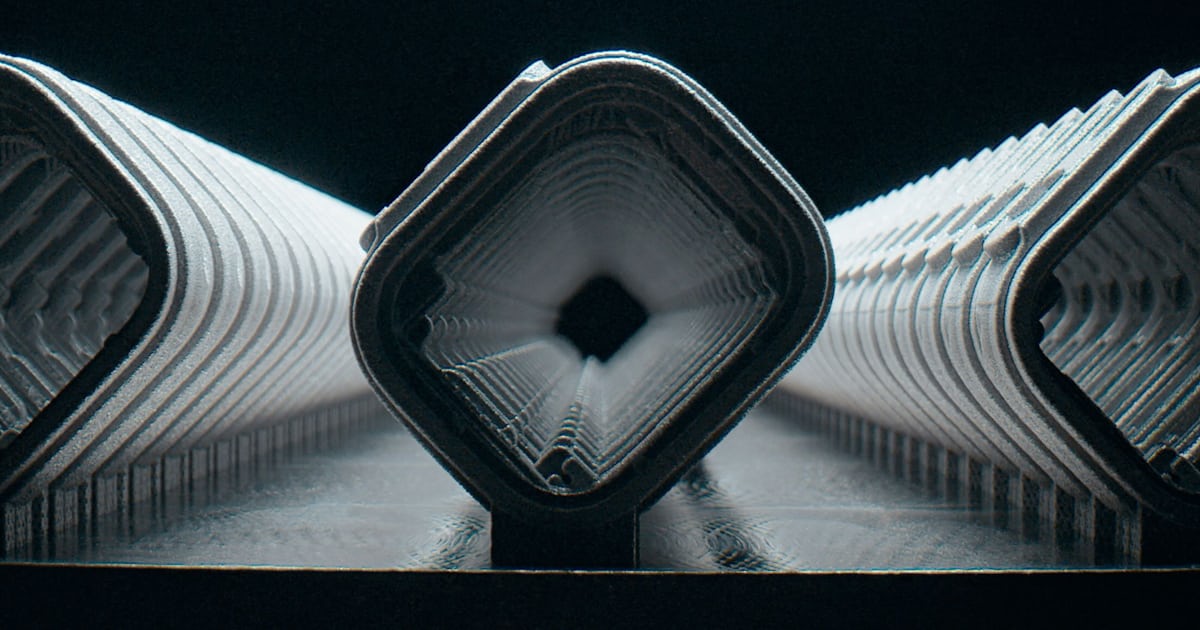
Once you have the titanium in powder form with the correct composition, a 60-micron layer of the powder is then spread onto the build plate. Then, six lasers move through the layer of powder, as seen in the video above, melting and fusing the powdered titanium into a solid at the specified areas of the predetermined print file. Once that layer is complete, the build plate moves down one layer’s depth, then a new layer of powder is spread onto the build plate, ready for the lasers to do the work again. Rinse and repeat over 900 times across twenty hours, and you get something very close to the final Apple Watch case.
When I first learned about Laser Powder Bed Fusion a few years back, it was quite hard for me to wrap my head around the fact that, rather than seeing an object rise up layer by layer, the entire build hides in the bed of powder as it gets constructed, sinking downwards into the material and only showing the final result once all of the layers has been sintered. The final reveal comes in this next rough de-powder step, where the printed cases rise out of the powder bed, and most of the loose titanium powder is vacuumed away. A progressively finer de-powder process occurs after this step, as trace amounts of the titanium powder must be removed from all the small nooks and crannies of the cases, thanks to pressurized argon and an ultrasonic shaker that vibrates the powder loose. At both de-powder steps, the titanium powder is reclaimed for future prints.

The finished prints rise from the bed of titanium powder in this step, where the loose powder is also vacuumed away to reclaim for future prints.

The fine depowdering step uses the ultrasonic shaker to remove any remaining loose powder from the cases.

A thin diamond-embedded wire separates the cases from the build plate, with each part then sent to automated inspection.
The cases are printed on the build plate in an upright, diagonal orientation, with each case standing on one of its corners and attached via a support base that’s part of the print itself. A diamond wire saw is used to cut the cases from the base, and finally, you have the makings of an Apple Watch case. But the process isn’t finished here. Each case is marked with a barcode for traceability, and a computerized system verifies that each case meets quality control standards in terms of dimensions and cosmetic appearance. The video below shows the barcodes being engraved, followed by the automated optical inspection system.
Once these steps are completed, the cases leave the 3D-print suppliers and travel to the traditional enclosure manufacturing sites that specialize in CNC and finishing processes, just like a previously forged Apple Watch case might at these steps. It’s these final steps that take the 3D-printed case and finish the grainy surfaces into sandblasted or polished results, identical to past examples. For the fully polished Series 11 cases, each case undergoes Hot Isostatic Pressing, which, at a high level, seals the pores in the cases and prepares the surface for the final polishing.
The Impact
For such a significant undertaking, these changes are virtually imperceptible to the wearer, hiding much of what makes this manufacturing so special. While the cases appear identical from the outside, Bergeron notes that the new 3D-printed construction incorporates structural features unattainable with traditional CNC machining. “As you can imagine, you are somewhat limited by whatever manufacturing technology you choose,” she tells me, “and we’re able to mold our antenna windows and create our water sealing by adding some additional features into the metal that we actually weren’t able to do machining-wise.”
However, some of the most significant implications emerge when you consider the broader context. “I feel like we might be underselling the fact that this is half the material, which is a tremendous unlock,” Chandler explains to me. “Normally, I get really excited about 5% material efficiency improvement. So this is a big deal. Even once you unlock 3D printing, the belief was that you couldn’t do it with recycled titanium powder. But why?” Bergeron then tells me that product development at Apple is like an extreme team sport, and when the ball leaves one team’s court, the other teams come together to figure it out. Designers, engineers, and material scientists must work closely with manufacturing and operations, as well as other teams, to crack the proverbial nut. And eventually, they did.


Admittedly, there appears to be fatigue with perceived greenwashing when traditional watch brands promote recycled-metal cases, only for the actual environmental impact to be quite insignificant due to relatively small production runs. However, by contrast, Apple operates on a significantly larger scale, and these numbers actually mean something when the recycled metal is combined with the much more efficient 3D-printing process. This year alone, Apple estimates that more than 400 metric tons of raw titanium will be saved from the switch to the new process. That’s not too shabby.
What interests me most is how this shift ultimately feeds back into design. The Series 11 still carries much of the visual DNA of the original Apple Watch from 2014, but a fully scaled new manufacturing process opens the door to far more freedom in considering its form. That freedom may pave the way for unexpected discoveries, and maybe even ideas worth noting for folks over in Switzerland. I can’t help but wonder how mechanical movement design might evolve as case interiors become more creatively engineered and more traditional watchmakers adopt these next-generation processes.
For more, visit Apple.
Source: www.hodinkee.com — original article published 2025-11-18 14:00:00.
Read the full story on www.hodinkee.com → [source_url]