Editor’s pick — Accessory quick take: key highlight (movement/specs for watches, materials/finish, limited run, pricing tier) in 1–2 lines.

What We Know
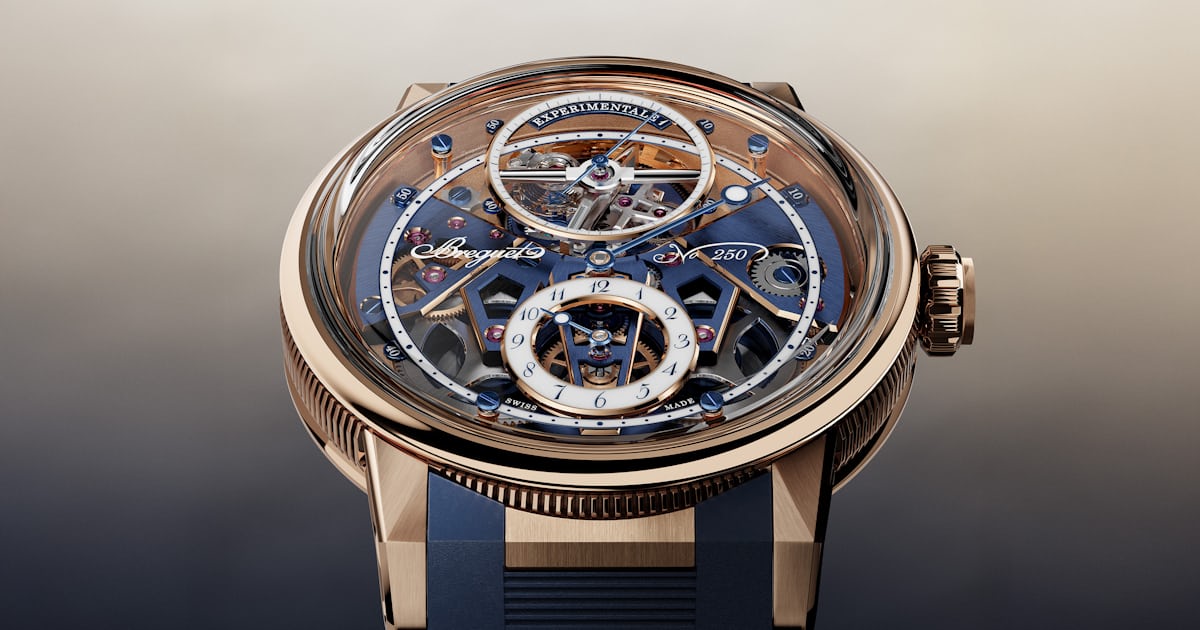
The whole of Abraham-Louis Breguet’s developmental history is hard to boil down to a single focus. Breguet’s pursuit of chronometry and his perfection and implementation of his contemporary John Arnold’s tourbillon concept are probably at the top of the list. Today, as the pièce de résistance for the brand’s 250th Anniversary, Breguet is not just announcing a new watch but a new “Experimentale” collection. The Experimentale 1 is a new 10Hz magnetic constant-force natural escapement tourbillon in a newly-redesigned Marine-style 18k Breguet gold case measuring 43.5mm by 13.3mm with 100m of water resistance.

All visual updates aside (which I’ll get to shortly), the technical achievement of the new Caliber 7250 takes the front seat here. This is a double-barrel movement with 72 hours of power reserve across two barrels and four springs (blued, a first for Breguet), but that’s almost not notable, in some ways, against the backdrop of everything else.
Instead, the star is the new magnetic escapement, made of two wheels in grade two titanium, with two magnetic tracks inserted. Those tracks feature in a ramp design of increasing and decreasing levels of magnetism. Instead of a traditional Swiss lever escapement, the new pallet lever uses samarium–cobalt magnets to replace the jewels (the same samarium-cobalt is attached to the escape wheels), enabling a frictionless, natural escapement, while the lever itself is nickel-phosphate.

The function is incredibly difficult to convey in text, but I’ll do my best. First, the central regulation is due to repulsion between the magnetic tracks on the escape wheels and the magnets inside the pallets. If you notice, these two wheels have a narrower edge at one side, which becomes thicker until the “spoke”. This is the “ramp” that I’ll refer to below.

Let’s imagine the system has already completed its supplementary arch. It is “locked,” with the left side of the lever (as seen above) pushing against the banking pin at the top of the pallet lever, while the lower pallet on that leading edge is held in place by magnetic force. As the going train applies torque to the wheel, the system is under maximum tension, with the silicon hairspring and balance pushing back.
The pallet fork, with its magnet at the end, is in the broader part of the escape wheel, which means it is under the strongest magnetic force. In the unlocking phase, the self-starting movement releases; however, the escape wheel remains stationary. The energy given to the fork of the lever by the impulse pin pushes the pallet up and out of the area of maximum magnetic force. It is then “ejected” from that part of the escape wheel by the magnetic force.

At the same time, the repositioning force (previously held off by the magnetism of the pallet) allows the going train to shift the balance wheel, also shifting the location of the “ramp” effect and the stop between the two wheels. The second pallet then enters and crosses the lower-intensity fields on the ramp. This “charges” the system again. Just as in the Swiss lever escapement, the pallet contacts the stop wheel between the two tracks (but not the tracks themselves) during the stopping moment.
This contact only stops the pallet from rotating, but there is no contact during the impulse phase, so the escapement has no friction during the impulse. The impulse is then magnetically provided to the arm, which is stopped, pushing it out of the escape wheel. Impulse here is independent of the torque available at the escape wheel. That means the same amount of energy is transmitted regardless of the power left in the system, making it a constant-force system. So to recap: constant force, zero friction during impulse. The 10Hz beat comes from the rate determined by the strength of the “ramp” to the magnetism at the escape wheels. The ticking sound itself is unusual as there are are two clicks, one for the stop wheel impacting the pallet and the other of the impact provided by the impulse pin on the fork, which aren’t in sync with each other (otherwise it would be locked up, of course).

The watch features the new Poiçoin Breguet, the third model since its introduction just last month, which offers various levels of guaranteed accuracy depending on the type of watch. This “scientific” model has an accuracy of ± 1 second per day and, like all Breguet Hallmark watches, has been tested to 600 gauss. This magnetic resistance is enhanced by the fact that the balance spring is made of silicon, the fixed fourth wheel is made of LIGA nickel-phosphore, and the other components are of titanium or Nivagauss (in the latter case, specifically the staff for the magnetic balance). Main plates and bridges are made of 18k Breguet gold.

The movement is housed in a newly-designed 43.5 mm-diameter by 13.3mm Breguet gold case with an updated three-dimensional coin-edge midcase and hollowed-out close-set lugs with blue ALD-treated gold inlays. The crown also has a blue ALD-treated sandblasted gold inlay. The watch features a box-type sapphire crystal, glare-proofed on both sides, and hydrophobic to match the 100m water resistance, while the dial itself is crystal with a regulator-type display. There are the hours at 6 o’clock, offset minutes, and seconds on the one-minute tourbillon. Indications are on gold applied chapter rings with Super-LumiNova, so the entire track lights up under UV. The indications are in “Expérimentale 1” blue ALD-treated applique enhanced with Super-LumiNova. As a whole, it almost looks like enamel subdials. The entire aesthetic design is based on the Breguet no. 3448 delivered in 1820 to astronomer Alexis Bouvard. But interestingly, this is one of the few watches in the Marine case that features Breguet numerals.
Gregory Kissling, the still relatively new CEO of Breguet, said that we’ll see a trickle down of these developments or the same caliber in a new case. However, for now, the new E001BH is limited to 75 numbered pieces to be delivered over the next year and a half or so, each priced at CHF 320,000.
What We Think
This is what Breguet is all about. Abraham-Louis Breguet was always experimenting, coming up with new ways to solve problems, both obvious and practical ones, and even those that few people would notice. This is an exciting approach to a natural, constant force escapement. Friction and magnetism are two of the main enemies of the practical function of a watch over the long term. Here, you use one “problem” to fix another. Yes, the system is hard to understand in text, but in person, it becomes much simpler. The watch is equally impressive on the wrist. Yes, it is a bit large, but the impact is great, and the interchangeable strap system and 100m water resistance add a bit of practicality to the watch, albeit one that costs almost $400,000.

One question that I had during the presentation mirrors a similar concern with the magnetic pivot in the recently relaunched 10Hz reference 7225: to paraphrase the Insane Clown Posse, “freaking magnets… how do they work?” But in all seriousness, my understanding was that most magnets will lose some strength over time, and basically are already continuously losing that force the moment they start interacting with each other (at least in frequency). It turns out I was wrong. In an interview with Kissling after the launch, he said there’s no expected demagnetization on the parts, due in part to the magnets used and how they’re used. Turns out there’s a lot more to know about how all this works. For more on that, the history of magnetic escapements, and the escapement as a whole, we’ll dig deeper in a future hands-on.
The Basics
Brand: Breguet
Model: Experimentale 1
Reference Number: E001BH/S9/5ZV
Diameter: 43.5mm
Thickness: 13.3mm
Case Material: 18k Breguet gold
Dial Color: Sapphire dial with tracks for minutes and seconds and hour subdials
Indexes: Blue ALD-treated applique
Lume: Tracks with Super-LumiNova
Water Resistance: 100m
Strap/Bracelet: Blue rubber with tool-free interchangeability; Interchangeable 18K Breguet gold pin buckle
The Movement
Caliber: Caliber 7250
Functions: Small hours, regulator minutes, small seconds
Diameter: 33.8mm
Thickness: 6.3mm
Power Reserve: 72 hours
Winding: Manual
Frequency: 10Hz
Jewels: 37
Chronometer Certified: Breguet Hallmark of ± 1 second per day
Additional Details: First constant-force magnetic escapement; 10 Hz tourbillon is used as the timekeeping basis; Samarium cobalt magnets; Balance-spring made of silicon; fixed fourth wheel made of LIGA (NiP12) and the other components of titanium or Nivagauss
Pricing & Availability
Price: CHF 320,000
Availability: Now, with pieces delivered over the next 2.5 years
Limited Edition: 75 individually-numbered pieces
For more, click here.
Source: www.hodinkee.com — original article published 2025-12-01 13:00:00.
Read the full story on www.hodinkee.com → [source_url]