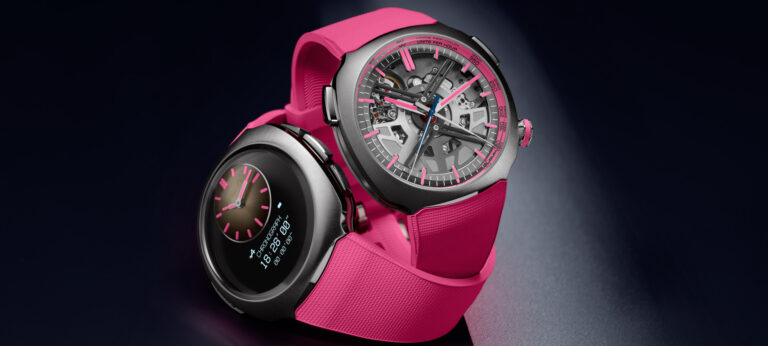
Editor’s pick — Accessory quick take: key highlight (movement/specs for watches, materials/finish, limited run, pricing tier) in 1–2 lines.

Deeksha Sharma likes watches. On an overcast morning in Bengaluru, India, earlier this year, she popped into a local Zimson watch store to pick up a new bracelet for her Swiss-made Rado and to browse the latest models in stock at the Indian retailer that’s been selling watches since 1948. Sharma has a corporate job at an international pharmaceutical company and also owns a couple of Tissots that were gifts from her parents. She’s part of the upwardly mobile group of young Indian professionals who are driving a new generation of interest in timepieces.
“People are aware. Watches show your taste, and they also show your socio-economic status,” she says. “The people around me know the watch brands now.”

Deeksha Sharma with her Rado watch at the Zimson store in Bengaluru.
India is, according to some industry executives and analysts, the next big growth opportunity for the luxury watch industry. As mainland China and Hong Kong–two of the main drivers of the increase in Swiss watch exports in the previous decade–pull back, India is trying to step in as the successor.
Swiss watch exports to India in 2024 surged to CHF 274 million, an increase of 25% compared to the year before and an impressive 46% since 2022, according to statistics compiled by the Federation of the Swiss Watch Industry. So far in 2025, Swiss watch exports to India are up about 9% while shipments to China are down more than 13%. While the U.S. remains the largest market for Swiss watch exports and one that’s continued to grow, tariffs and shifts in U.S. trade policy have prompted many Swiss watch brands, particularly those selling watches priced in lower-tier price segments, to increase their efforts and focus on alternative destinations, particularly India.
The Indian luxury watch market is currently estimated to be worth about $1.6 billion annually with the total watch market in India, including smart watches and wearables worth about $3 billion, according to analysts and financial reports. That’s still relatively small compared to major markets in North America, Europe and Asia, but what’s so enticing about India are its projections for growth as its population gets richer and looks to luxury watches increasingly as status symbols and stores of value. India and Switzerland have signed a Free Trade Agreement that will sharply reduce current punishing tariffs on Swiss watches over the next seven years. Some estimates for compound annual growth rates peg India’s luxury watch market growing to a projected value of $2.8 billion by 2033 with the total Indian watch market (including non-luxury and smartwatches) expected to reach $5.13 billion by 2033.

Estimated growth of India’s luxury watch market and total watch market between 2025 and 2033.
Sources: Statista, Alboom, Knight Frank, Hodinkee
“We are the perfect brand for India. The mid-segment is getting bigger, and people are getting financially stronger,” says Niels Eggerding, the Chief Executive of Frederique Constant, the value-oriented Swiss luxury watch brand owned by Japan’s Citizen Group. Eggerding says Frederique Constant has nearly tripled sales in India in the past few years, and the country has vaulted into the top 10 markets for the brand.
At UK-based Bremont, under new ownership since 2024, India now represents its fourth largest market behind the U.K., U.S., and the Middle East, according to Davide Cerrato, Bremont’s CEO. “We definitely believe that the potential is huge and that it will be the next big thing after China,” Cerrato says.

Watch retailers at the UB City Mall in Bengaluru.
The CEOs aren’t alone in their bullish view of India. A survey of watch industry executives conducted by Deloitte Switzerland found that 79% expected medium to strong growth from India over the following 12 months. But whether India can truly ever replace China or other large markets as a core engine of large-scale sales for the international luxury watch industry, is very much still up for debate. The market is not fully open to outsiders, particularly in retail, where local partners must be employed under regulations that prevents most foreign brands from selling directly to clients

Deloitte Switzerland asked watch industry executives what regions they expect to grow most quickly in the next year.
Sources: Deloitte Switzerland
At the Ethos Summit watch boutique at the UB City Mall in Bengaluru, a steady stream of customers is visiting the retailer, where brands range from IWC to Jacob & Co. to Favre Leuba (the Swiss brand in which the retailer owns a controlling stake) to H. Moser & Cie and Zenith. Client relationship executive, G.C. Pradhan, says sales at the store have grown by an average of about 30% a year for the past eight years.
Like much of the rest of the market, customers are increasingly moving upscale, and they’re becoming better informed about what watches they want and why. These days, he says, he is getting inundated with requests for one brand in particular, A. Lange & Sohne, which Ethos doesn’t carry in India. Pradhan says many of his business clients use watches to express their interests, wealth, and status. “You can’t carry your car to a business meeting, but you can wear your watch,” he says.

The exterior of an Ethos Summit multi-brand watch boutique in Bengaluru.
With a population of about 1.4 billion, India has already overtaken China to become the world’s most populous country. Its liberalized economy has grown rapidly under the government of Narendra Modi, the Prime Minister since 2014, nearly doubling in size over the past decade. It’s now the fifth-largest economy in the world by some measures, but its per capita GDP still trails other major developing economies significantly, with the average annual income per person of about $2,700 in 2024, according to the World Bank. That still trails China significantly, where the average annual income per capita is about $13,300.
Still, India is producing millionaires and ‘High Net Worth Individuals’ (HNWI) at a rapid pace, and its middle class is growing significantly. With a median age of 28, India has one of the youngest populations in the world, according to a recent report on the country’s economy by Roland Berger. India’s ‘middle class’ with an income between about $6,000 and $34,900 is expected to account for about 46% of the population by 2030 and about 60% by 2047, the report says. Depending on its size and scope, the so-called ‘middle-class’ of a country can drive general consumer trends and interests in an outsized fashion compared to other income groups.

Deeksha Sharma’s Rado was a gift from her husband.
That means opportunity not only for Swiss, Japanese, and German watch brands, but also domestic producers from India, such as the Bangalore Watch Company, a seven-year-old brand that makes robust tool watches often based on India’s achievements in aerospace, aviation, exploration, and sport. Featuring Swiss-made movements, in-house designs, and local assembly, the Bangalore Watch Company plans to open its first boutique in its home city this year.
With its timepieces aimed at reflecting a modern and confident India, most of its customers are in its home country. But the brand’s co-founder and CEO Nirupesh Joshi says it remains a challenge to sell watches at its price point to some domestic consumers.
“It’s easier to sell a $1,500 watch outside of India than it is in India, because in India, you need the touch and the feel, the tactile and the practical sense of it,” he says. That’s one of the reasons for the new boutique, as a relatively expensive luxury watch is not something all Indians are comfortable with buying online.

A pair of Mach 1 Syncro watches from Bangalore Watch Company.
Photo Credit: Bangalore Watch Company
Like the India market and the watch market in general, BWC has been moving to produce more complex, technical, and expensive watches and move some of its products more upscale. It’s now making a meteorite dial watch and held a workshop at Dubai Watch Week to demonstrate their techniques using the high-end dial materials.
“Discretionary spending is growing. Disposable incomes are higher than ever. So it’s a good time if you’re building a premium brand with a premium positioning,” Joshi says of the India market and the prospects for luxury watch brands. “Whether the market has the acceptance for an Indian brand to position at a premium, it’s still questionable, and that’s the challenge that we’ve been working against for the past seven years. But we’re seeing bright spots.”

The Apogee Manzinus II.
Photo Credit: Bangalore Watch Company

BWC Admiral.
Photo credit: Bangalore Watch Company

BWC Cover Drive.
Photo credit: Bangalore Watch Company
The Bangalore Watch Company is an upstart compared to Titan, India’s biggest watchmaker that produces some 15 million watches a year, mostly quartz and mainly for the domestic market. Visiting Bengaluru-based Titan and its industrial manufacturing facilities in nearby Hosur was the main reason we were in India earlier this year, as the brand was launching the Jalsa, an ambitious, tourbillon watch cased in rose gold with an extraordinary and unique dial hand-painted by a renowned Indian artist.

Titan’s latest watch with a wandering hours complication.
Photo credit: Titan Group
Backed by India’s biggest conglomerate, the Tata Group, Titan is a domestic powerhouse with more than 40 years of history. With a far-reaching retail network and new ambitions to produce higher-end quality watches, it’s perhaps among the best-positioned companies to meet the new, richer Indian watch consumer as they upgrade what’s on their wrist. The recently installed head of Watches and Wearables at Titan, Kuruvilla Markose, who has held leadership roles across the company for more than two decades, says not only Titan watches but also the company’s Helios retail empire is preparing to make the move to meet the more upscale Indian watch consumer.
While the 280 Helios stores across some 100 cities in India serve primarily entry-level watch consumers with Titan watches priced at a few hundred dollars or less and a number of fashion watch brands as well, the company’s new Helios Luxe stores will sell watches priced at as much as $2,000 or $3,000 and up, Markose said in an interview during Dubai Watch Week in the United Arab Emirates, which is Titan’s second largest market outside its home country.
Markose says Helios Luxe has already opened about five stores, including at the New Delhi airport, with plans for rapid expansion.
“The few stores that we’ve opened are doing extremely well, and customers are very excited. We want to attract more brands because there’s no one else in India who has the distribution reach that we have,” Markose says, noting that Titan is represented in thousands of other points of sale across the country. “What we want to do with the Helios Luxe is offer a platform for both international brands as well as Titan brands to come together and, as you go up in price points, what we realize is consumers don’t want to come in and see one brand alone. They want choices.”

Titan’s manufacture in Hosur, Tamil Nadu, India.
Photo credit: Titan
If U.S. tariffs on Swiss goods have been a challenge for the watch industry, consider India’s current plight. It’s facing tariffs of 50% for goods imported to the U.S. right now, a levy that has hit jewelry makers, including Titan, hard. Still, executives are confident that India and the U.S. will strike a deal and that India’s economic growth will carry on, largely uninterrupted.
“That story is intact,” Markose says. “India today is soon expected to become the fourth-largest economy. It’s expected to cross Japan, and by 2030, predictions are that it will become larger than Germany and become, therefore, the third largest economy in the world, after the US and China. So that story for the next 15 years, from 2025 to 2040, I really see India doing what China did from 2000 to 2025,” Markose says.

Vishwas, a top sales person at Zimson in Bengaluru, says the average price of watches he sells has increased substantially.
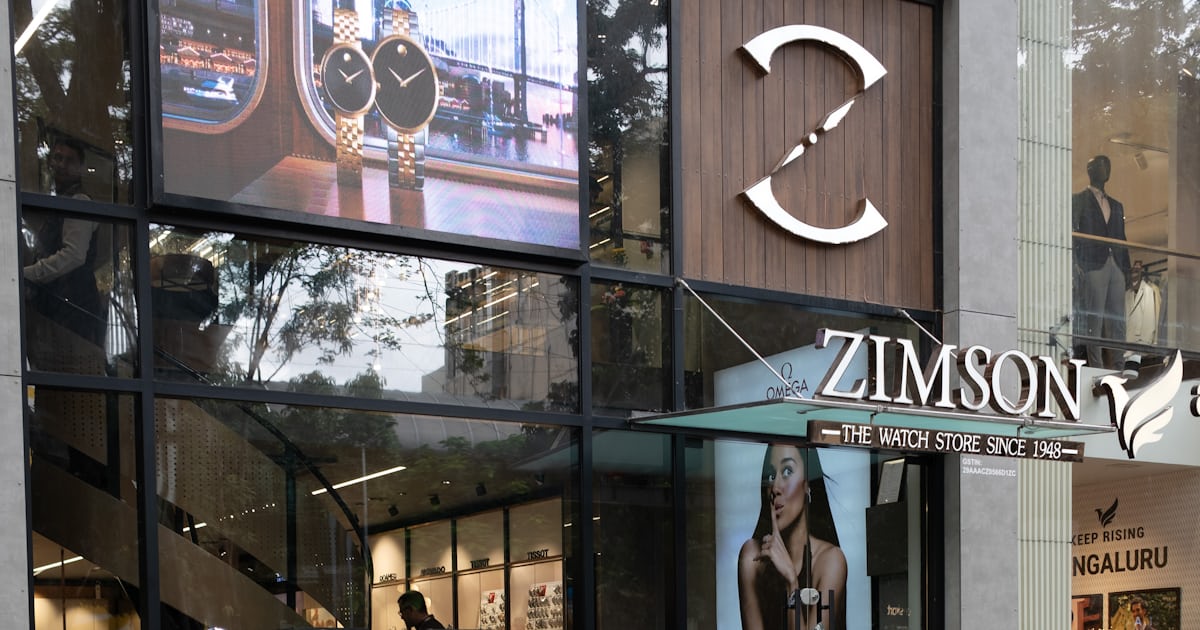
Back in Bengaluru, on a teeming shopping street, there is a cluster of watch shops, including a busy Helios outlet selling Titans and international brand watches, including entry-priced Frederique Constant pieces. Beside the Helios shop is the two-level Zimson store where Deeksha Sharma got her Rado strap replaced, and Omega and Chopard are among the high-end pieces on offer.
Vishwas B, a veteran and top sales associate, says the average price of the watches he’s selling has nearly doubled in the eight years since he’s been at the store, from about $400 to close to $1,000. He says the widespread accessibility and adoption of the internet in India has pushed watch culture and watch enthusiast sites like Hodinkee to more mainstream consumers and to a new, younger generation that wants to spend more on luxury items, including watches.
“Now people know most of the well-recognized brands. Beyond Rado, they now know Breguet, Blancpain, Breitling, Tag Heuer, and Omega. All these people know about the watches,” Vishwas says. “This generation, they are more eager to spend on watches and other luxury.”
Source: www.hodinkee.com — original article published 2025-12-03 18:00:00.
Read the full story on www.hodinkee.com → [source_url]