Editor’s pick — Accessory quick take: key highlight (movement/specs for watches, materials/finish, limited run, pricing tier) in 1–2 lines.

When the Hublot Big Bang launched in 2005, watches were already growing in size. In truth, everything was. If the naughty nineties marked the mainstreaming of grunge, baggy denim, oversized flannels, and hip-hop’s visual codes, the early 2000s extended that logic into a more overt culture of excess. One defined by logomania, spectacle, and Juicy Couture tracksuits.
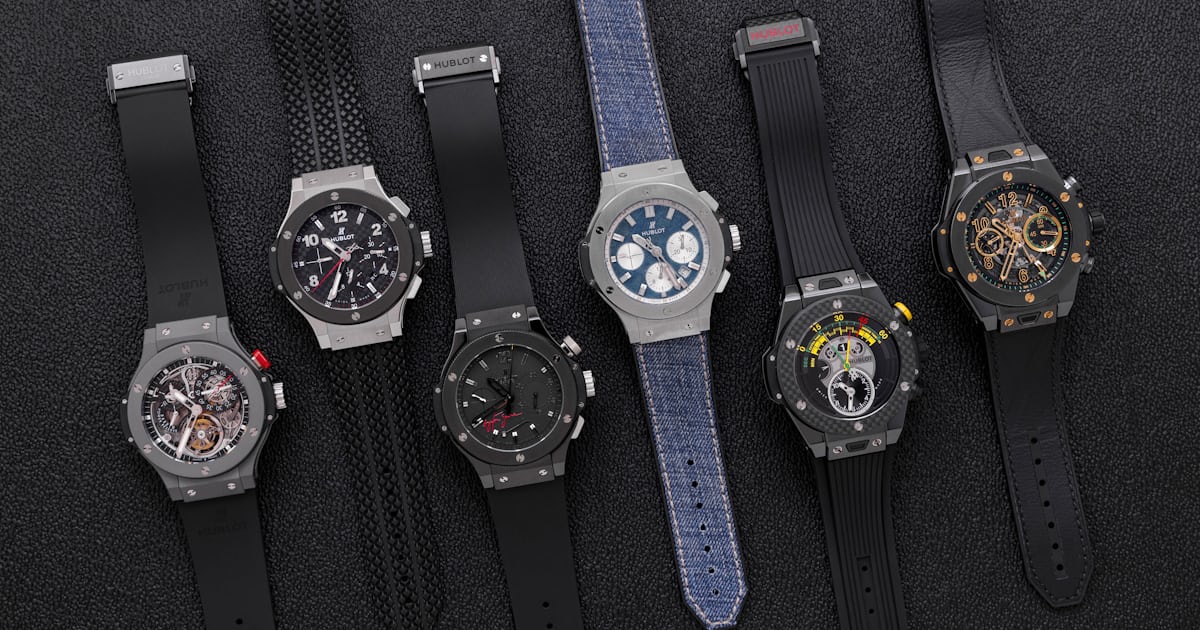
The Big Bang announced itself with aplomb. The case was oversized at 44 millimeters, it featured a chronograph function, and a bezel punctuated by exposed screws. Its construction involved a very non-traditional combination of materials: steel or red gold paired with titanium, ceramic, carbon fiber, Kevlar, and rubber. That same year, the design was awarded the Grand Prix d’Horlogerie de Genève, a formal acknowledgment that something new, and intentionally disruptive, had entered the chat.

Big Bang Steel Ceramic 44mm


Seen against this wider cultural backdrop, the Big Bang’s proportions were not radical so much as inevitable. Oversizing had become a dominant visual language, cutting across subcultures, age groups, and modes of self-expression. Post-9/11 fashion saw Louis Vuitton’s monogram transformed into a Murakami rainbow fantasia; Burberry checked just about every object that could be checked; Gucci’s double Gs festooned belt buckles; while John Galliano’s Dior reveled in narrative excess and maximalist fantasy. Size, visibility, and exaggeration were no longer transgressive gestures. They were the point. As logos grew louder, material identity became increasingly performative.
Watches followed suit and went supersize. Panerai’s Luminor, Audemars Piguet’s Royal Oak Offshore, Hublot’s Big Bang, and Jacob & Co.’s Five Time Zone each expanded the physical and symbolic footprint of the wristwatch, though they arrived there by different means. The Offshore’s rubber accents and exaggerated case echoed the era’s fascination with extremity and physical bravado, aligning high luxury with the aesthetics of sport and spectacle. Panerai framed its size through military utility and historical legitimacy, using provenance to justify mass. IWC’s Big Pilot operated in a similar register, grounding its scale in instrument logic and functional necessity. Jacob & Co., by contrast, dispensed with restraint altogether. The Five Time Zone anchored scale to celebrity visibility and pop-cultural immediacy, an outlier to traditional Swiss watchmaking by virtue of its ties to 47th Street. It became an essential ingredient in the recipe of mid-2000s watch culture. Oversized watches moved from Diamond District flash to military mythology to something increasingly Genta-adjacent. Each step normalized scale further, until size itself became the message.

Left: Heidi Klum Image: Courtesy of London Entertainment / Shutterstock; Right: Jay Z Image: Courtesy of Jacob & Co.
To situate the cultural cut-through of oversized watches, it helps to look at what watch collecting had become post-quartz crisis. In the 1990s, the dominant archetypal figure was an antiquarian collector with a reverence for pocketwatches. The early 2000s ushered in the intellectual collector: reference-driven, historically literate, fluent in complications and calibers. By the mid-to-late 2000s, that figure gave way to something else entirely: the cultural collector. Watches soon became vehicles for virtue signaling, shorthand for taste, belonging, and status.
Collecting in the early to mid ’00s was inextricably linked to internet forum culture. But picking your online tribe was a fickle business. Paneristi, AP forums, brand-specific message boards. These spaces didn’t just discuss watches; they produced consensus. Taste spread collectively. A brand functioned almost like a religion, offering an almost messianic sense of purpose. Ironically, the Big Bang—a name evoking science and cosmology—wasn’t tied to anything concrete at all. That looseness made it malleable. It functioned less like an object of scholarship and more like an accessory.

One collector I spoke with who was active on the forums at the time remembers the intensity clearly. “When I first started using the Panerai forum in 2004 or 2005, the site would crash every day at about 12 p.m. U.K. time,” he recalls. “That’s when the Americans came online.” That same collector remembers how quickly allegiance shifted. “For six months, the AP forum would be the hottest place to be, everyone posting their Offshore Chronos. Then it would be all the Panerai guys. Then it would be Hublot. Then everyone would go back to Rolex. There was this constant migration, like people trying on different narratives. Maybe it was imposter syndrome. Maybe it was people trying to be something they weren’t.”

This was the era of herd mentality and monopolistic presence, when particular watches dominated particular segments of society. Your watch functioned as an accessory, but also as a declaration. It was a direct projection of your station in society, in a way that feels almost foreign today. Now, of course, we like to imagine ourselves as self-empowered connoisseurs, existing in a post-forum world where identity is supposedly self-authored on Instagram rather than collectively reinforced in forums. But in the mid-to-late 2000s, watches were louder, more tribal, and more performative. Scale only served to reinforce that herd mentality.
What distinguished the Big Bang from its contemporaries was not an escalation of aggression, but a surprising lightness. Where the Offshore was tightly defined by sport and Panerai by utility and history, the Big Bang arrived comparatively unburdened. Its identity was open-ended, its references diffuse, its communication less weighted by the expectations of traditional watch culture. Rather than anchoring itself to an inherited narrative, it aligned with the fashion moment itself: Fluid, expressive, and immediately legible. In that looseness lay its foresight. The Big Bang behaved like a cultural object before the industry was ready to acknowledge that watches could do so.

Big Bang Jeans Steel 44mm (2016)
“The Big Bang was fresher,” recalls the founder of independent watch brand Pattern Recognition, Michael Friedman. “Even though it was big, it felt lighter; lighter colors, lighter tones, lighter communication. The Offshore was so defined and anchored in sport. The Big Bang was more approachable. It was less defined.”
Industry titan and CEO of Hublot from 2004 to 2012, Jean-Claude Biver understood this instinctively. His genius was not invention so much as recognition, a cultural antenna tuned to visibility, celebrity, and momentum. Biver did not create the culture surrounding the Big Bang; he recognized it and brought it into focus, guided by a sharp instinct for the zeitgeist.
“What Biver was always good at was injecting culture into a brand,” Michael Friedman says. “With Hublot, he stepped outside watch culture and looked at broader culture instead.” The Big Bang sits precisely at that inflection point: when visibility overtook discretion, and when watches stopped pretending they existed outside the logic of fashion, celebrity, and spectacle.

Biver at the Bond St store opening in 2011. Image: Courtesy of Getty.
If the Big Bang was a harbinger, what followed was inevitability. Its open-endedness, aesthetic, cultural, and ideological, made it uniquely mobile. The watch did not require explanation or insider literacy to function. It could travel. This was the golden age of oversized watches, buoyed by a highly marketable image of machismo, visibility, and power.

Actor Jamie Foxx was presented with a custom Hublot watch at the LA Confidential party in 2005. Image: Courtesy of Getty.
The Big Bang did not invent flex culture; it arrived precisely when flex became de rigueur. Pre-GFC liquidity and youth culture created a moment in which permanence mattered less than presence. No one was thinking about resale. No one was thinking about legacy. The watch existed to be seen. “It was really a product of its time,” Friedman has noted.
“There was much less emphasis on movements back then,” recalls Miami-based collector Josh Krut, who began collecting in the mid-2000s. He remembers the Big Bang less as an object of horological debate than as a reflection of the culture surrounding it. “It was more about design,” he says. “The shortcomings didn’t matter as much.” In Miami, Krut remembers seeing the watch everywhere—paired with True Religion denim and the first wave of Murakami-era Louis Vuitton bags. “Everything was very loud,” he says. “It was flashy, but it fit in.”
And nightlife mattered in this ecosystem as a proving ground. Clubs, parties, and late-night spots were where watches were seen repeatedly. Places where cultural signals circulated quickly and hierarchy was established visually. In that context, recognition mattered more than nuance. A watch had to register instantly, across a room, without explanation. Nothing was subtle — not the watches, nor the luminous bottles of Dom.


Kobe Bryant and the former CEO of Hublot, Ricardo Guadalupe, in 2013. Image courtesy of Getty.
The Big Bang’s visibility was not a by-product of success; it was the strategy. Worn by A-list musicians, elite athletes, and artists, it timed World Cup finals and appeared on Olympic podiums. It moved easily between music, sport, and fashion, collapsing the distance between high luxury and mass culture. Love it or loathe it, there is no denying the impact the Big Bang has had on watchmaking and popular culture in the two decades since its introduction.
But that strategy was neither organic nor accidental. Biver arrived at Hublot with a clear playbook, honed during his tenure at Omega, where he helped institutionalize the deep integration of brand ambassadors into product identity, from hiring Cindy Crawford to anchor the Constellation line to cementing James Bond as an Omega figure after Pierce Brosnan wore the Seamaster in GoldenEye. At Hublot, that logic was pushed further and made more explicit. The Big Bang’s presence in hip-hop culture, including paid placement with Jay-Z, and its aggressive move into football sponsorship were not side effects of popularity, but deliberate infrastructure.

Left: Wayne Rooney in 2011; Right: Usain Bolt also in 2011. Images courtesy of Getty

Big Bang Unico Usain Bolt Ceramic 45mm (2016)
Football (call it soccer if you must), in particular, proved decisive. At the time, the sport was still widely considered too popular—even tacky—to align with high luxury. That tension was precisely the point. Hublot entered football before the rest of the industry was comfortable doing so: sponsoring the Swiss national team in 2006, becoming an official UEFA partner in 2008, and by 2010 positioning itself at the center of the World Cup. “Remember when Hublot entered football, football was considered a popular sport, never linked to luxury,” the current CEO of Hublot, Julien Tornare, later reflected. “Now look at all the brands.”

Pele and Kylian Mbappe. Image Courtesy of Hublot.

Big Bang Unico Chronograph Retrograde World Cup Black Ceramic Carbon 45mm (2014).
The Big Bang’s presence became difficult to avoid. It appeared repeatedly across sport, music, and popular culture, reshaping how watches were seen and talked about. “It was really a revolution in the watch industry,” explains the current CEO of Hublot, Julien Tornare. “Probably the first iconic watch of the Swiss watch industry of the twenty-first century. And it came with a change in mindset.” That change was not driven by mechanical novelty. The movement quality was known and likely consciously deprioritized. Design, visibility, and cultural presence were the value proposition. “Big Bang is a big watch by definition,” Tornare says. “And that was a time when bigger was starting, but not really there yet. Hublot helped create that trend.” Fusion became the guiding philosophy. Not only of materials, but of references and worlds. “There was a fusion of materials, yes,” Tornare adds, “but it was really about bringing different things together, in a very conservative environment, with a very disruptive approach.”
By the 2010s, Hublot’s cultural standing sat conspicuously alongside Rolex, Patek Philippe, and Audemars Piguet, a fact reflected in its appearance in rap lyrics, where brand inclusion functions less as endorsement than as cultural accounting. To be named is to be counted. In Jay-Z’s Otis (2011), Hublot appears not as a novelty but as a peer: “New watch alert, Hublots / Or the big-face Rollie, I got two of those.” The line places the Big Bang squarely within the same register of visibility and value as Rolex, underscoring just how fully it had entered the cultural ledger.

Jay-Z at the world preview of the Shawn Carter Watches by Hublot in Zurich in 2013.
In this context, the Big Bang’s perceived excess was not a flaw but a feature. Its scale, contrast, and visual insistence mirrored the moment itself. What critics would later dismiss as loud or unserious was, at the time, precisely the point. The watch did not aspire to timelessness. It aspired to relevance. What the Big Bang revealed—uncomfortably, and earlier than most—was that watches had already crossed a threshold. They no longer operated solely as objects of connoisseurship or heritage, but as participants in a broader cultural economy.
Speaking with a collector who witnessed the Big Bang’s ascent in real time, a clear throughline emerged between that moment and what Hublot continues to do best. For him, the brand’s most coherent positioning is not a retreat into horological orthodoxy, but a sustained alignment with contemporary art, a field that, like the Big Bang itself, operates through expression, material experimentation, and cultural immediacy. “The smartest thing Hublot can keep doing is leaning into that world,” he told me. Not because the watches lack substance, but because contemporary art, particularly at the scale Hublot engages with, is fundamentally about visibility, surface, and impact. In practice, that logic is already embedded in the brand. Collaborations with artists including Takashi Murakami, Shepard Fairey, Richard Orlinski, Maxime Plescia-Büchi, and Samuel Ross do not sit outside Hublot’s history. They extend it, translating the Big Bang’s cultural fluency into another register.

Hublot ambassador contemporary artist Daniel Arsham.

Last year Hublot announced Patrick Mahomes as a brand ambassador. A big move for Hublot and the US market.
Hublot is explicit about what the next phase requires. Under Julien Tornare, the emphasis has shifted toward watchmaking substance, not to disown the past, but to make its credibility unmistakable in a landscape that now demands transparency. “At the time, movement innovation wasn’t what defined the Big Bang,” Tornare has said. “The focus was on design, presence, and material fusion. Today, that’s something we’re deliberately balancing with stronger watchmaking.” Taken together, these positions aren’t in conflict. They describe a brand shaped by cultural visibility, now working to make that visibility durable.
In fashion, the inexplicable wild style of the Y2K era—thong-exposing low-rise jeans, bedazzled pastel sweatsuits, logo-covered designer everything—has now eclipsed the reign of the ’90s. The oversized watch of the early 2000s has not reappeared in the same way. But an ode to that excess can’t stay quiet for long. Gazing back at the mid-2000s has become an obsession for millennials eager to recapture a time when anything felt possible, and for Gen Z, newly curious about the years just before many of them were born. The renewed fascination with the period from roughly 2004 to 2013 has already produced an unusually broad range of reboots and reappraisals.

Today, Hublot occupies a less ubiquitous position than it did in the mid-‘aughts, but it seems comfortable courting controversy rather than shapeshifting to fit the broader movement of “taste.” In an industry that often mistakes restraint for credibility, surely the most powerful brands remain the most identifiable?
We’ve been declaring the “end of logos” and, alternately, the “rise of stealth wealth” for decades now. There are cycles when one is more ubiquitous than the other (usually having to do with economic downturns), but they both exist in tandem. They help define each other. It’s a pendulum. And the oversized watch belongs to one end of its swing.
Source: www.hodinkee.com — original article published 2026-01-16 20:00:00.
Read the full story on www.hodinkee.com → [source_url]