Editor’s pick — Accessory quick take: key highlight (movement/specs for watches, materials/finish, limited run, pricing tier) in 1–2 lines.

It’s not that often that one of the biggest brands in high-end watchmaking launches a new collection, and the Neo Frame Jumping Hour couldn’t come at a better time for Audemars Piguet. On the heels of the brand’s 150th Anniversary, not long after the 50th anniversary of the Royal Oak, just after the sendoff to their RD line with the impressive RD#5, it was time for a fresh start. But what does that start look like? It turns out, it looks a lot like the past, revamped for the modern market.

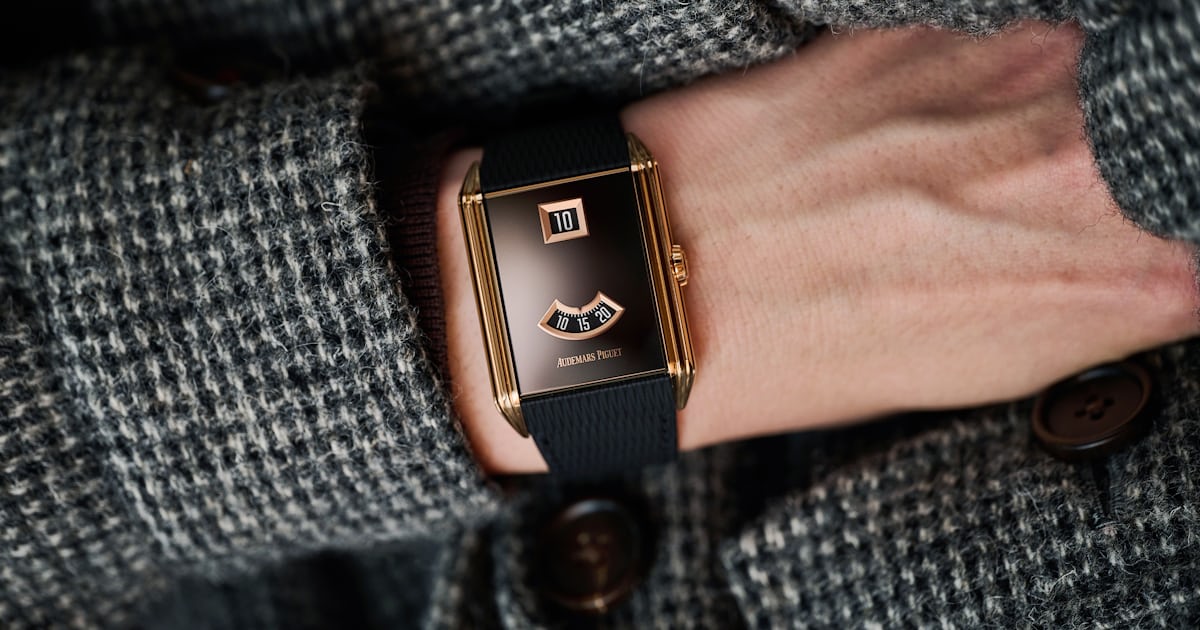
Here’s the brief. The Neo Frame Jumping Hour is a new watch, launching both the first-ever fully in-house jumping hour caliber from Audemars Piguet and a new collection that will evolve over the coming years. The 18k pink gold case measures 34.6mm from top to bottom, 34mm across (from one gadroon to the other), and 47.1mm lug-to-lug.
The thickness is 8.8mm, and the watch is powered by an automatic movement. Instead of a traditional dial, time is displayed via two apertures: one for the hour that jumps forward at the top of the hour, the other for the minutes that “wander” or rotate. I’ll give you my rundown of how it feels on the wrist shortly, but first, I want to give people context of AP’s history with jump hours.
Why History Matter and What’s In A Collection
Few brands launch a collection on the back of one watch. It’s a lot to carry. The Neo Frame Jumping Hour shares that burden, drawing on 14 examples of pre-reference Audemars Piguet watches from 1929 and 1930. One of those watches, a rare white-metal piece, was part of Marcus Margulies’ collection that AP bought to help fill out its museum. The brand now owns three of the fourteen examples of that model, so happy hunting if you’re looking for the original. It’s one of those watches that vintage collectors know, and those who have them hold them close.

A pre-reference 1271 Audemars Piguet from 1929. These watches measured 25mm across (including the lugs) and 25mm from top to bottom of the frame.
Jumping hours have certainly been… well let’s just say they’ve been popular lately. Maybe people are even over-indexed on them, which got worse with the announcement of two jumping hours in the same week. With that popularity comes an added awareness, but sometimes a lack of context.
The commentary that AP is just copying another brand misses a lot in terms of context and history. It also misses the fact that a brand, even one as adaptable as AP, can’t just see that other brands have gotten success with jumping hour display over the past year or so and say, “let’s rush one out quick.” A movement like this takes a lot more work than that, let alone a case.

A jump hour pocket watch, made by who? Patek? AP? Cartier? No, this is an 1880s IWC made by Josef Pallweber.
As for history, Antoine Blondeau invented the jumping hour for King Louis Philippe I around 1830; Austrian engineer Josef Pallweber patented and mass-produced pocket watches featuring a jump hour in 1883 with IWC (which did a wristwatch in tribute to him in 2017). In 1928, Niton launched its first jump-hour display. That same year, Cartier introduced the Tank à Guichets, using the same LeCoultre GHSM movement that AP used for its pre-reference 1271 model in 1929. That’s why they look so much alike.
The case for the Cartier was made by Edmond Jaeger. With a LeCoultre movement and a Jaeger case, does that make the Tank less of a Cartier, or a copy of someone else’s idea? This was common at the time, so similar watches from different countries shouldn’t come as a surprise. So who gets credit? LeCoultre? Pallweber? Blondeau? I’d just say that trends sweep everyone up.

A 1926 Audemars Piguet jump hour powered by a 10 ligne GHSM 17/12 movement.

An Audemars Piguet ref. 25723 from the mid-1990s.

A Jules Audemars Openworked Jumping Hour Minute Repeater.
I kind of slow-rolled this reveal, but not only does AP have a long history of making aperture-based watches, but they also made ones that actually predate the Cartier Tank à Guichets or their pre-reference 1271. The watches (including the one above, made in 1926) were powered by a 10GHSM17/12 movement with central minutes, small seconds, and a jumping hour, and were on display at AP’s event earlier this week.
As I read the press release, I thought of the John Shaeffer Jump Hour Minute Repeater and the rectangular references that preceded it, the Jules Audemars Jump Hour Minute Repeater, and a few pocket watches (which, similarly to the wristwatches, seemed to have shared movements with watches stamped by other brands like Van Cleef & Arpels). If you didn’t know all this before, you know it now.
The jumping hour is a beautiful complication. I think it responds also to the desire for extreme simplicity in watches.
Ilaria Resta, CEO of Audemars Piguet
So, instead of debating who came first, my first question was, “What makes a Neo Frame, so we can know what to expect in the future?” My next question was, “How does this wear and how is the legibility?” The latter we’ll get to shortly. As for the former question, according to AP’s CEO Ilaria Resta and others from the brand, you can expect the Neo Frame collection to feature shaped watches, though not always this shape, and more creative uses of aperture-based design.
The brand needed a more vertical design to round out their options on the market (no pun intended), and the Neo Frame Jumping Hour provides that. But for more context, you can look at the previously mentioned watches plus the Star Wheel, which AP groups with its “aperture-based displays,” for a signal of where the model might go. As for why there are so many jump hours on the market now, Resta had this to say.

The relaunch of the Audemars Piguet Starwheel, in the Code 11.59 case. Could we see this in a Neo Frame watch? Dear lord, I hope so.
“The jumping hour is a beautiful complication. I think it responds also to the desire for extreme simplicity in watches. The shape fits very nicely with the jumping hour when you do that. That shape is a happy coincidence, and when it happens, it creates a movement, right? It creates even more people interested in that complication and shape.”
The launch of the new collection is an important moment for the brand, but also a chance to quiet AP’s detractors. According to sources within the brand, the narrative of Audemars Piguet as a mono-collection brand built around the Royal Oak has been a sore spot. However, even I mentally lump the Royal Oak, Offshore, and Concept under the broader Genta-originated umbrella, leaving the Code 11.59 as the second pillar on which the brand engaged with the market. I think many would agree the Code had a bit of a wobbly launch, but the product has only gotten stronger. Sure, there’s the [RE]Master line as well, which at this point is planned to continue with limited-edition releases sprinkled throughout the options.

For now, [RE]Master will be the limited edition yet more open-ended design platform for Audemars Piguet.
I also question whether a third collection (or fourth, counting [RE]Master) needs to be a “collection” at all, at least in the way that the Royal Oak and Code are. The question probably misses the forest for the trees (or in this case, I’m belaboring something here and not getting to the watch… but it’s coming, I promise). If you look at Patek Philippe, they have a few—the Nautilus, Aquanaut, Calatrava, Cubitus, the often-forgotten Twenty~4, and others—but many of their most interesting and compelling complications appear in watches with no cohesive collection or design across the broader range.
No matter the name on the dial, good design is good design, catchy name or not, and rigidity can stifle creativity. Maybe that’s a path for AP moving forward. And yet, for now, a house with three pillars, now including the Neo Frame, is undoubtedly stronger than it was. It will just take a while to see how the collection fills out. But for now, we’ve got a watch to look at.
The Neo Frame Jumping Hour
Alright, enough of the philosophical musing, let’s get to the new watch in the metal. The most frequent question I got after the release (and I got dozens of DMs in the first day or so) was, knowing I’d seen the watch in person, how big the Neo Frame Jumping Hour actually is. The original press release from AP stated the dimensions as 24.8mm by 34mm. That was, frankly, shocking to me. That makes it about the size of a large Cartier Tank Must (33.7mm x 25.5mm) and not much larger than the Tank à Guichets. It was also impossible—the case width was smaller than the movement diameter. A number of publications still use those measurements, some now use updated measurements that match ours, and some use a third set altogether. Which presents a question: how are you measuring a rectangle?

Cartier measures the entire case, from brancard to brancard (the line that runs up and down the 3 and 9 o’clock sides of the case and acts as the lugs) and from lug to lug. A Jaeger-LeCoultre Reverso is measured the same way. That’s become the common way we understand how a rectangular watch wears, and that experience really does differ from that of a round watch. But for whatever reason, that’s not how AP measured their first rectangular watch in decades.

I asked the brand for some more specific measurements, and within 30 minutes, I had them, so credit to the brand and the team for that. I’m going to just publish them in full here, as I understand them (illustrated below). Measurements may be +/- a few tenths of a millimeter:
- Width with crown: 35.7mm
- Width without crown: 34mm
- Width inside (the frame dial): 25mm
- Length of Crystal: 34mm
- Total Length (lug-to-lug): 47.1mm.

An illustration of the new measurements provided by Audemars Piguet. Photo courtesy Audemars Piguet. Illustration by Mark Kauzlarich/Hodinkee.
For more context, here are some useful comparisons:
- Jaeger-LeCoultre Reverso Duoface: 47mm by 28.3mm and 10.3mm thick
- Jaeger-LeCoultre Reverso Monoface: 45.6mm by 27.4 mm and 8.53mm thick
- Cartier Tank Must in Extra-Large: 41mm by 31 mm, and 8.4 mm thick
- Tudor Black Bay 58: 39mm wide, 47.75mm lug-to-lug, and 11.9mm thick.

A comparison of the AP Neo Frame Jumping Hour and Jaeger-LeCoultre Reverso Duoface, done to scale. Photo courtesy Audemars Piguet. Illustration by Mark Kauzlarich/Hodinkee.
If you’ve ever tried on any of these watches, or maybe all of them, these measurements should serve as a good frame of reference (since I didn’t have any similar watches to compare with the Jumping Hour). I’ve also posted pictures below of my colleague Masaharu Wada from Hodinkee Japan wearing the watch on his 15.5cm (6.1 inch) wrist and an (admittedly not great) cellphone photo on my larger 7.5 inch wrist. As you can see, the Neo Frame Jumping Hour wears very much like a slightly wider, slightly thinner JLC Reverso Duoface, thanks to its similarly flat caseback and short, downturned lugs. And yet, it looks like Wada-san can pull it off quite well for all those very reasons.

A photo of the Neo Frame Jumping Hour on Masaharu Wada’s wrist, albeit slightly higher on the wrist.

An iPhone photo on my 7.25″ wrist.
In the case of these AP releases, we wrote our “Introducing” stories before seeing the watch in person, so it was hard to make size judgments. After seeing the watch in person, as a vintage lover, it was certainly larger than I would have hoped. It would have been an incredibly surprising and bold move to release a 34mm by 24mm watch, and it would certainly have pleased a ton of vintage collectors. But I can understand why that’s not practical for the brand. For all the comments on Instagram or readers of watch blogs, AP has to reach a wider audience, and a smaller watch probably wouldn’t do that (in the same way a manual movement will 99% of the time be a downside for an average non-enthusiast customer, and even a significant number of enthusiasts). A first release doesn’t preclude a smaller watch in the future, however, and while some women certainly can pull this off, those with smaller wrists would probably love to see something smaller.
There are also upsides. You can see that, while it’s much larger than many enthusiasts probably hoped, it’s also significantly (and I emphasize significantly) more legible at a glance than the Cartier Tank à Guichets. I’m a huge fan of the Cartier from a design standpoint and even (somewhat dreamingly) put myself on the list for one last year, even though it’s out of my budget. But that’s purely an emotional and design-driven longing—I’ve loved the Tank à Guichets since hearing about them from Eric Ku (I think) early in my days of watch discovery—and basically anyone I know that loves that watch, even those that own one, will say that it’s not legible. The Neo Frame Jumping Hour’s bold, art deco-inspired font and larger dial apertures make it a more practical user experience.

Again, on Masaharu Wada’s 6.1 inch wrist.

According to Resta, the Neo Frame Jumping Hour and the collection at large was largely a “form follows function” moment for the brand.
“I think it all starts from the movement,” she said in an interview with U.S. press at the AP Social Club event in Switzerland. “The discussion is we’re doing lots of work on enriching the family of our complications. And as you know, we have many complications we don’t do today, some we used to do in the past, some we have never done in-house.
We are interested in developing these complications. The jumping hour is an interesting complication that didn’t fit, honestly, in either of the two shapes we have, the octagon [Royal Oak] or the Code case, while it fits very nicely in an old model that we have in the past. And that was the thinking. While I have the open expectation and, honestly, pretty much the confidence that this will work, you can never bet on something and say, ‘This will represent so much of the family.’ We need to learn as we go. I truly believe, though, that this shape has proven successful in the past and is relevant today.”

Audemars Piguet CEO Ilaria Resta wearing one of the brand’s three examples of the pre-reference 1271 jump hour watches from c. 1929-1930.
Size preferences aside, I think that AP did a good job reimagining the aesthetic of what they call the Art Deco-inspired “Streamline” pre-reference 1271. Even with the brand’s [RE]Master releases, they’re not in the business of one-to-one reissues but modernized takes on the classics. The lugs are shaped to add visual complexity (and I’m sure they were hard to make and to finish). Instead of sticking with a brushed front surface (like the original) and drawing more comparisons to other models, the use of a sapphire dial with PVD undercoating, melded to the case’s frame, creates a strong impact. The new texture-embossed calfskin strap keeps the Neo Frame Jumping Hour from feeling too formal, but another dressier option is included.

This is what happens when the crystal reflects a warm-toned wood ceiling. Actually, an all-rose dial would be quite cool.


It also shifts in the light and picks up hues from its surroundings, while remaining legible. The time-telling discs have a subtle texture that contrasts with the sapphire front. If I had to be picky about the aesthetics, the pink-gold logo font is a bit bold for the otherwise clean aesthetic. Would I have liked an all-metal two-tone version like shown above? Yes, but I can easily see the model’s framework lending itself to that eventually, or to enameled dials and other Metiers d’Art, which seem to be an increasing focus for the brand.

Three unique Metiers d’Art versions of the Audemars Piguet CODE 11.59 Grande Sonnerie Supersonnerie, including one for the collector @chronopeace (in the center). The brand has previously worked with Anita Porchet on similar pieces, but it’s unclear whether these were made by her or her workshop. Photos courtesy Audemars Piguet.
I saw the idea, floated online, that a smoked sapphire crystal to show the movement would be nice. I like that, in concept, as it would make the watch even more modern, but there are two issues: first, the crystal is part of the case frame, so you’d lose a bit of that magic infinity-edge case design. The second is that the two discs largely cover the movement, as shown in the illustration they showed us during the presentation. You’d see a small portion of the movement, but you’d also see mostly disc and empty space where the round movement doesn’t fill the rectangular case. The smoked effect might actually look great, slightly obfuscating the discs enough to maintain legibility, but it’s not exactly what AP was going for this time.

The next question people will have about how the watch functions is how snappy the jumping hour actually is. Some brands make jumping hours that are semi-instantaneous, creeping over to the next hour. The base caliber 7121 from the Jumbo is doing its job here: being an adaptable platform for other complications. The new, first-ever in-house automatic jumping-hour AP Caliber 7122 has a quick, brisk snap that’s not jarring. There doesn’t seem to be any rebound (that I could perceive) when you roll over to the top of the hour. The watch has a 52-hour power reserve and runs at 4Hz.

The Neo Frame Jumping Hour isn’t nearly as thick as a manual-winding jump hour, but it is proportional.
I know some people might have preferred a manual-winding movement for thinness; however, ergonomics seems to be the word of AP for the foreseeable future, and was mentioned a lot during product presentations. The easy-setting QP movement, the smaller in-house chronograph—these recent releases, like the automatic movement in the Neo Frame, are meant to make the watches more wearable for a wider audience. I would guess that most customers for this watch would prefer the automatic movement, even though enthusiasts would disagree. Rather than wishing for a manual caliber, it would have been nice to see a shaped movement in the Neo Frame, or one with a microrotor. It’s easier to develop off an existing base, and more affordable, I’m sure, but it’s a detail like that which would really set the Neo Frame Jumping Hour apart.
The Neo Frame Jumping Hour will be available from AP retailers and boutiques as a non-limited-edition piece, retailing at $71,200. With the rising cost of gold, these are the prices we have to adjust to today, which will put pressure on retailers and customers in a similar fashion.
Market Comparison
Cartier Tank à Guichets
In terms of iconic status and price, the first and most obvious comparison is Cartier’s Tank à Guichets, relaunched at Watches and Wonders last year. Don’t be surprised if you hear the word guichets used to describe any of these watches. It’s French for “window” and is the way the displays are often described. The Tank à Guichets is more compact, measuring 37.6mm lug-to-lug by 24.8 mm, and significantly flatter, without dropped lugs. As a manually-wound watch, the thickness is only 6mm. It’s a small-sized “if you know, you know” release from a brand with a lot of clout in this kind of thing. But it’s also incredibly illegible for most people. It looks great, wears great, and then the aperture and font are just too small.

From our review of the Cartier Tank à Guichets last year.
There was actually not a lot of information given about the in-house Cartier Caliber 9755 MC in the Tank à Guichets at launch. Without a display caseback, it was still hard to glean much in person. Manually wound and with only 40 hours of power reserve, it falls technically short of the AP on paper, but some of those compromises make it more compact. In my experience, people engage with Cartier watches more as design pieces than high horology, and while the case finishing is far more simplistic and legibility is worse (in my experience), Cartier has over 100 years of experience building this model into an icon. The price of the Tank à Guichets at launch was $47,000 in yellow or rose gold, which is significantly more affordable than the Neo Frame Jumping Hour. On the secondary market, however, people are asking $145,000 or more for the Tank à Guichets currently, which makes AP’s release a bargain by comparison.
Jaeger-LeCoultre Reverso Tribute Nonantième

Photo courtesy Jaeger-LeCoultre.
It’s easy to see the comparison to the Reverso, and there is, in fact, a Reverso on the market with a jump-hour display—kind of. The Reverso Tribute Nonantième only has a semi-instantaneous jump hour, which starts to creep forward at about 5 minutes to the top of the hour before fully jumping over, kind of like a date disc would. But that’s obviously only half the story with the Reverso. The digital display side also has a rotating disc with moon and sun for day/night indication. But as a Reverso, the Nonantième has a whole second display with traditional hands, a large date, small seconds, and moonphase on the “front.”
That level of maximalism comes with a maximalist case size: 49.4mm by 29.9mm and 11.72mm thick, which, from personal experience, wears far too big (or moreso, long) for a lot of people. It’s also hand-wound, not automatic. The most recent version in pink gold upgraded the Métiers d’Art, using enamel and lacquer on the rear dial. The retail price for that version is $74,000, putting it in line with AP’s release.
Niton ‘Prima’ Souscription

The most recent entrant to the modern market is another old brand that only recently announced its return. If you want more comprehensive information on the watch, you can read our recent story. The Prima is available in 38 pieces (19 each in platinum and rose gold), measuring 27mm by 35.5mm with a 42mm lug-to-lug and only 7.9mm thick. The movement was developed by Niton and is more complicated (a sonnerie au passage and chronometer-certified movement), but manually wound. Some people will prefer Niton’s style, like taking a gamble on a new brand, and will spend $58,000. Others might want to pay an extra $13,000 for the AP. It might have been the most unfortunate-timed launch, competing with a brand that makes 1315x their production, or the perfect time, as more people will be thinking about jumping hours and looking at their options.
Neo-Vintage Audemars Piguet references 25723, 25765, 25793, 25814, and 25823 Jumping Hour Minute Repeaters

The Audemars Piguet ref. 25723OR, in the most common configuration for this and all similar references. Photo courtesy Phillips.
I really love neo-vintage Audemars Piguet. Before the John Shaeffer minute-repeating jump-hour models (which I covered here), the same caliber 2865 movement (designed by Giulio Papi for AP when he was at Renaud & Papi, so therefore not in-house) was used in the closest similar option, a rectangular neo-vintage release from AP. More than just a jump hour like the Neo Frame, the ref. 25723 had central minutes and a minute repeater. The watches were followed by variations, such as the ref. 25823, ref. 25765PT (with ruby or emerald and mother-of-pearl dials), ref. 25793 (even more intricately set with diamonds, emeralds, or sapphires on the case and lugs), ref. 25814 (in yellow gold with diamonds and four different stone dials). All of these examples can be seen in the book Audemars Piguet 20th Century Complicated Wristwatches.

These references were launched in 1992, made until 1996, and sold until 2003, with 208 examples across all references in platinum, yellow gold, and pink gold. The watch, like the Neo Frame Jumping Hour, featured a round movement in a rectangular case. But these cases were smaller, 29mm by 38mm, even with the inclusion of the somewhat thin-sounding minute repeater, and were manual-winding. While they don’t come up for sale often, the price has steadily crept up over the past few years, and a yellow gold example has gone from around $70,000 in 2023 to near $100,000 today. A gem-set version might cost over $250,000 today. About $30,000 more than the current release gets you a minute repeater, which might be enticing for some buyers, but it might be hard to get.
Final Thoughts
The choice to dig into the brand’s history for such an obscure inspiration surprised me, but I can see the logic. Maybe the brand finds the Jules Audemars (which some of our audience seem to miss) too recent to revive or too ubiquitous and somewhat staid with a round case. I’m biased toward thinking the Shaeffer collection might have been a good option for a revival, but it is relatively recent as well. More than that, either would compete against their own secondary markets–you could just buy the more affordable older version than the new one.

This is a very pragmatic decision, and while I lack the creativity to fully imagine where else the brand goes from here, there are certainly options. Minute repeater jump hours seem like an obvious choice. Calendar watches might not be too far-fetched, as AP did make pocket watches with aperture-based calendars (likely using the same parts providers that brands like Van Cleef & Arpels and others used in the early 20th Century). It’s also hard to imagine any watch with hands fitting in the “frame” mandate. But in a way, that makes the unseen and unimagined potential all the more exciting. It’s been a while since a brand promised a whole world of opportunities based around an idea that few saw coming.
For more on the Audemars Piguet Neo Frame Jumping Hour, visit the brand’s website.
Source: www.hodinkee.com — original article published 2026-02-06 16:00:00.
Read the full story on www.hodinkee.com → [source_url]