Editor’s pick — Accessory quick take: key highlight (movement/specs for watches, materials/finish, limited run, pricing tier) in 1–2 lines.

Happy April, folks. The Midwest is doing its annual “can’t-make-up-its-mind” dance. I swing from desultory frustration at having to wear long pants as the mercury dips to hopeful thrill at finally being able to wear shorts and be outside without muttering curse words. Then the whole shuffle repeats, seemingly every few days, and I distract myself with watches. I hope wherever you are is more manageable.
Scorekeeping last week’s picks: both the Omega 3953 and the tropical Zenith A384 passed, which results are simultaneously disappointing (because they’re lovely watches and should sell) and thrilling (because maybe they’re both evidence that the market is moving in a direction that allows easier access to great watches). The 14k gold Tissot Ch 27 sold for $3,000, and the Ball Official RR Standard sold for $325.
Strays
Given the irregularity with which they turn up, I feel obligated to point out this LeCoultre Futurematic in a ‘jumbo’ steel case, though to be clear, you only buy this watch if you are truly unhinged and want to own, for as long as you can tolerate it, a watch you will almost certainly never get right. Will you ever find an original Ref E501 dial? Unlikely. What you’re buying, if you choose this chase, is an endless quest, an opportunity to always be, if only a little, unsatisfied. It’s not quite Marcus Brody’s “The search for the grail is the search for the divine in all of us,” from Indiana Jones, but who has the time, energy, and resources to search for the actual grail? Here’s a better, safer, just as unrealistic opportunity.

If impossible quests aren’t on your April 2026 Bingo card, perhaps you’re down for a Goodwill Seiko Pogue. It’s not a true Pogue, as it lacks the Resist badge on the dial. Still, it’s a nice-enough later example of the reference, and Goodwill Pogues generally go for a premium simply because Pogues are so commonly messed with. Also on Goodwill, there’s a two-tone Datejust still sporting its caseback sticker, but maybe what you’ve been hankering for of late is a classic redone with a quartz movement. In that case, here’s a lovely Oysterquartz 17000 with a blue dial that looks like it’s been turned into the night sky itself, and here’s a quartz Speedmaster from long, long before Swatch and Omega dreamed up MoonSwatches. Finally, in the when-it-rains-it-pours category, here’s a Girard Perregaux 9034 “Roulette.” A few weeks back, I noted a “Playboy” model of the same reference, and now feel basically obligated to note this one. Pursue as you see fit.
Onto the main event.
Minerva Triple Date Moonphase Chronograph
Bonhams is hosting an auction titled Property of a Noble Collector, and regardless of what anyone’s collection ends up looking like, it’d be thrilling to be called, even after one’s eventual demise, a Noble Collector, wouldn’t it? Though presumably most of us would hope our own nobility would preclude our having amassed quite so many redialed watches (or otherwise messed with timepieces).
However, if you slog through the less noble offerings, this auction offers a veritable smorgasbord of riveting horology to choose from. There’s a 1990s Bucherer Perpetual Calendar, an alluring Mido Mystery Dial, and a Doxa Sfygmos. As if that wasn’t enough, there’s also an inordinately uncommon Angelus Tinkler (with, yes, the same dial/hands configuration as the one that sold on eBay for $10k in 2013).

However! If you slog through the less noble offerings, this auction offers a veritable smorgasbord of riveting horology to choose from. There’s a 1990s Bucherer Perpetual Calendar, an alluring Mido Mystery Dial, and a Doxa Sfygmos. As if that wasn’t enough, there’s also an inordinately uncommon Angelus Tinkler (with, yes, the same dial/hands configuration as the one that sold on eBay for $10k in 2013).

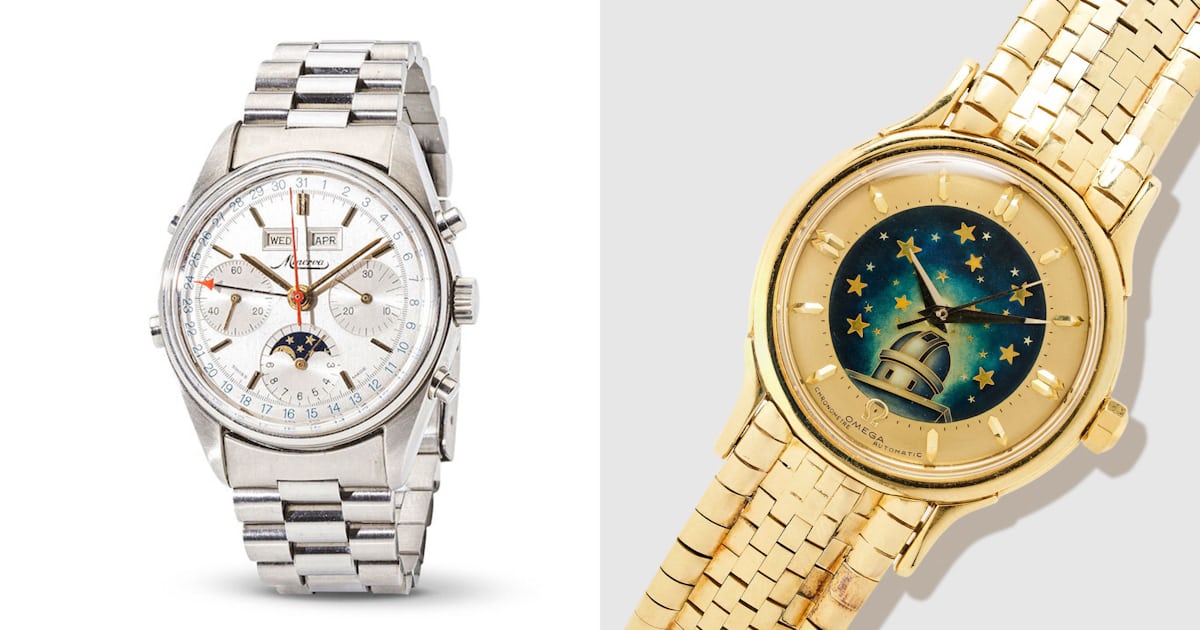
The watch I kept returning to was this Minerva triple-calendar. No need to adjust your monitor: yes, the watch in question’s a close cousin of the Rolex Jean-Claude Killy, except the Minerva’s got a moon phase to boot. It’s 35mm, and the watch looks to be in excellent shape, with the brushing on the case evident. Unlike the Rolex Killy, the Minerva has inverted pushers, which is neither here nor there, but they do look cool.
However.


The listing notes the watch is from the 1980s, which should give anyone pause. It looks too much like a 1950s example of a classic Minerva, right? Powered by a Valjoux 88? Except the listing notes this one is powered by a Valjoux 730. Hm. If you’re demented or determined enough to keep digging, you might ask Bonhams for more pictures and/or clarity, and, while awaiting their response, you may find yourself Googling Minerva triple date chronographs with moon phase powered by a Valjoux 730. If you do that you end up here, looking at a very similar watch, and if you scroll all the way to the bottom, a commenter notes (years after the original post) that that very similar watch, with a slightly different dial but a caseback identical to the one Bonhams is auctioning, is somehow neither a Minerva nor not a Minerva.
Hm again.

Ultimately, this seems like a sort of parts watch, assembled, presumably by Minerva, with leftover parts. Specifically, the inside of the caseback is marked Tourneau, and the chronograph bridge has been milled, leaving the movement unsigned (according to the commenter on the forum post linked to above, the movement was originally branded Wakmann). Further, the Valjoux 730 has been modified to include a moon phase. Plus then with more digging you may find this Tourneau reference 4356, which is of course the same watch as well.And then Bonhams emails with pictures that make clear the watch in the forum and the one on auction are not the same watch, but clearly from the same batch.
By now we’re asking sort of Ship of Theseus questions about this watch. Is this watch—likely assembled in the bleak 1980s, when manual-wound chronographs were notoriously under-appreciated—a Minerva, despite its unsigned movement and Tourneau case? At this point, if you’re like me, you’re sort of ready to throw up your hands and leave the philosophizing to someone else. I’m not sure what the watch is other than beautiful, and at some level, the correctness of anything has its limits. Bid up to €1100 at the time of writing, this Noble Collector’s collection goes up on the 8th of April.
Omega Constellation ref. 2699 with Cloisonné Dial

Here’s one of very few watches I’d say automatically earn a spot on any roundup of watches for sale. What you’re ogling is an 18k gold reference 2699 from 1954, one of very few made with a cloisonné dial of the same Geneva Observatory (technically, it’s the cupola of the Geneva Observatory) that’s found on the caseback of all Constellations.
Cloisonné dials—from the Omega website—involve “separating the coloured fields of an enamel design with minuscule gold threads smaller in diameter than a hair, practically tracing the outlines of the individual colour sections.” Not for nothing, these particular dials were commissioned by Omega from Stern Frères—not bad in terms of lineage. Given that enameling a dial is a multi-step, iterative process requiring multiple firings, the failure and/or rejection rate is notoriously high.
But good lord, when it all works out—I mean, just look at the thing.

The example on offer from The Keystone—for, yes, a very serious $400k—is hard to discuss objectively. If we were to remove the dial from consideration and treat it like, say, last week’s Omega Grand Luxe, I’d note the case looks sharp, and the bracelet itself is wildly uncommon. It looks to be in great shape, and all the specific parts of the watch (crown, hands) look correct and excellent for any 72-year-old watch, let alone one in 18k gold. I’d note that the watch is powered by a chronometer-grade bumper caliber 354, and, given that it’s mid-century Omega—basically the best era of one of the best watch companies ever—it would be an amazing watch, even without its phenomenal and rare dial.
But the dial is everything here, so critical and rare that all else (the caseback with almost no wear!) pales in comparison. Omega itself bought a 2699 with a cloisonné dial for its museum in 2007 for CHF 152,500, and Phillips sold one on an identical gold bracelet for CHF 106,250 in 2017. I couldn’t even guess whether $400k is the right price for this, but it’s an historically significant and rare watch, and once you reach such heights, the forces at play are more than I can imagine.
Certina ref. 8701.504

The auction catalog claims this Certina is “the first timepiece to feature a center-minute chronograph counter,” though that’s not true. As just one example, Mido’d made the Multi-Centerchrono long before this watch was born.
But let’s not let minor inaccuracies derail us from considering an otherwise compelling watch. You can tell from a glance this is a 1970s watch, all wild color and effortless groove. Made for the 1972 Olympics in Munich, this Chronolympic is also, clearly, a regatta timer. But wait, you’re saying, how is it clearly a regatta timer? And the answer is: a central minute counter.
Meaning, of course, that the very busy handstack goes, from top to bottom, chrono seconds, minute hand, chrono minute counter, hour hand. Banished entirely is the running seconds hand, and the hour totalizer’s still down there at 6.

If you look at the movement, you can actually tell immediately that something’s up. On a standard V72, you see two different wheels connected to the bridge. Still, on this modified Certina, there’s only one, and the one that’s missing is the minute counter, which has been shuffled elsewhere to be integrated in the central stack.
Bid up to $300 CAD at the time of writing, this example offers a whole lot of pleasure for what presumably will end up as a not-too-painful price. It is, at 40mm wide, a big slab of a watch, but who among us hasn’t woken up wondering if we’ve missed our calling? True, you won’t be able to actually travel back to 1972 and take part in any regatta, but wearing such a watch could offer a pleasant consolation. The auction takes place on April 9th.
Source: www.hodinkee.com — original article published 2026-04-03 15:00:33.
Read the full story on www.hodinkee.com → [source_url]