Editor’s pick — Accessory quick take: key highlight (movement/specs for watches, materials/finish, limited run, pricing tier) in 1–2 lines.

Somewhere between trend-led conversations, cultural influences, and layers of narrative, it’s easy to forget that watchmaking has always been about one thing: accuracy. From marine chronometers to George Daniels’ co-axial escapement, the path has taken different forms, but the goal hasn’t changed. In recent decades, that path has largely led to higher frequency—faster oscillations, more chances for errors to average out. The Dominique Renaud Pulse60, though, moves in the opposite direction.

At first glance, it looks like another fresh independent watch with a contemporary execution. Mechanically, however, it operates far outside conventional logic, oscillating at just 1 Hz, with a balance measuring 20 mm across and an amplitude exceeding 360 degrees. The Pulse60 approaches stability through inertia and control rather than speed, with this level of distinction not only theoretical but immediately visible the moment the watch is set in motion. Its natural half-beat dead seconds display, and torque indicator make that control visible, turning the watch into a literal expression of time, one pulse at a time.
,
Recently presented at Dominique Renaud’s headquarters in Tolochenaz, Switzerland, the watch feels less like a concept brought to life and more like the result of decades of knowledge and experience distilled into a single object. All of the experience has tangible benefits, as the team took less than two years to design, produce, and deliver these watches.

“I don’t see this pace of production as being impressive; it’s just being organized”, says Michel Nieto, CEO of ‘Haute Horlogerie Dominique Renaud’ (HHDR). “We’re not like the big brands that will have 10 or 20 projects in parallel. We have only one, and everyone is focused on that singular project”.
Few figures in watchmaking have shaped the industry as Dominique Renaud has. As co-founder of Renaud & Papi, later acquired by Audemars Piguet, Renaud played a central role in the development of some of the most ambitious high-complication movements of the late 20th century. Much of that earlier work pursued precision through complexity and, at times, extreme speed. Renaud previously experimented with ultra-high-frequency oscillators operating at 12 Hz with very small amplitudes, pushing the limits of rapid impulse delivery. Now, he’s gone the opposite way.
Control First
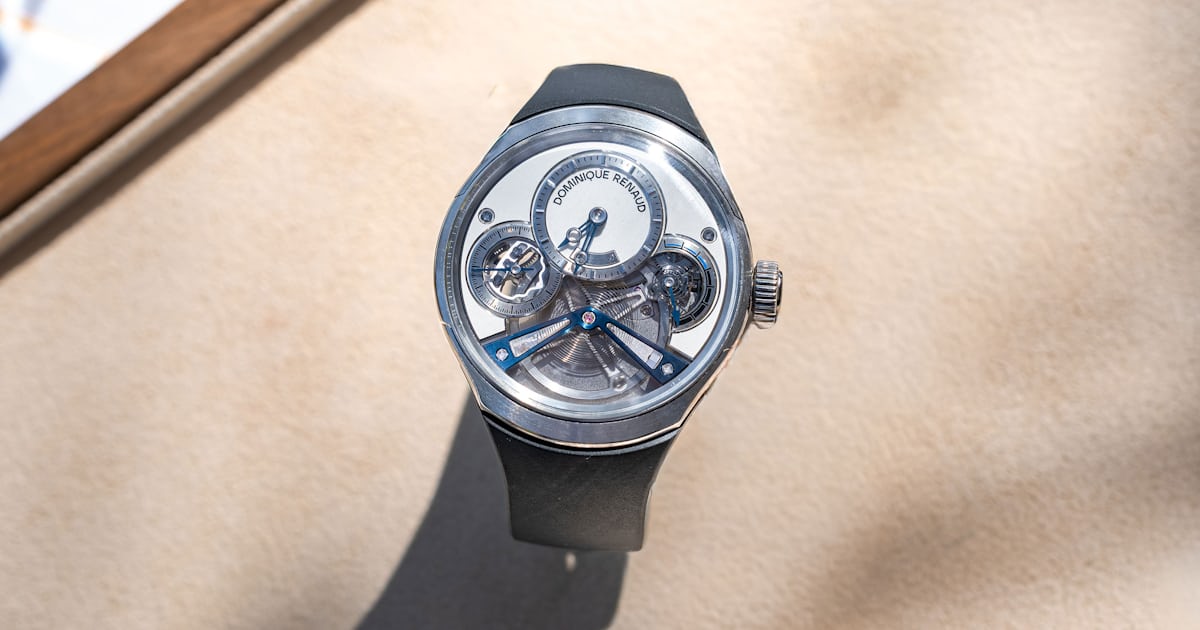
At the center of the Pulse60 sits its defining component, a 20 mm balance wheel, prominently displayed on the dial side. In mechanical terms, its size increases inertia, making the oscillator more resistant to small disturbances such as torque variation or minor shocks. In visual terms, it’s commanding, as it puts the watch’s technical nuance center stage.

At the brand’s HQ a few weeks ago, around Renaud’s desk, which looks out past the swimming pool onto Lake Geneva, there are many 3D-printed samples of mechanical innovations, and even the earliest examples are made out of Lego. Downstairs, a team of young watchmakers is working in their newly opened space as many of us gather for the full reveal of the watch. Upon launch, the watch is available in three configurations: grade 5 titanium with either a black or silver dial, and a two-tone pink gold and titanium version paired with a silver-and-grey guilloche dial.

Designing a movement to operate at just 1 Hz is not a simplification. Each oscillation lasts a full second, amplifying every disturbance; as such, stability cannot afford to be an afterthought and must be engineered in rather than corrected through repetition. Renaud also redesigned the regulating system to allow amplitude beyond 360 degrees without knocking. Most wristwatches deliberately limit amplitude to less than a full rotation, but here, allowing the balance to rotate beyond a full circle increases time in free oscillation, bringing the motion closer to an ideal harmonic state.
Getting Into The Dial
The Pulse60’s dial is built around a carefully considered cluster of round forms. The time display at twelve with pomme hands sits above two sub-registers for the seconds (including half-second markers due to the double movements per second) and the torque indicator, all orbiting the dominant balance. It’s a clever approach when paired with a lugless, round case – there’s such a high level of coherence with the Pulse60.

Across the titanium and two-tone models, the surfaces are clean and uncluttered, letting the half-beat dead seconds and torque indicator take center stage without ever feeling cramped. When it comes to the silver, there’s a strong sense of traditionalism in its styling, with its silver chapter rings and bluing throughout, but for the black dial, it’s a stealthy monochrome affair. And the two-tone pink gold and titanium version introduces a grey guilloche for subtle texture. Of the three, the two-tone reference feels closest to a second-generation watch, while black and silver are real classics on paper and in the flesh.
Above all else, what’s striking about the dial is how it makes a technical, unusual movement feel approachable and easy to reach for. Instead of seeing a balance vibrating in a way that appears caffeine-fueled, the motion becomes less of a blurry spectator sport and more of a readable, trackable one.
Hands-On
On paper, the Pulse60 measures 40 mm wide, 44 mm long, and 12 mm thick, and, thanks to the absence of traditional lugs, the way it wears isn’t exactly conventional. The word that comes to mind when strapping the Pulse60 on the wrist is therapeutic. So often, when I think of an independent watchmaker presenting a dial-side balance, I expect something moving so quickly that the watch feels like a hypercar. But with the Pulse60, the entire experience is slowed down. Handling the different versions highlights the subtle personality shifts between each model, from stealthy to traditional to refined. A prominent aspect of the Pulse60’s feel is just how contemporary the model feels. Today, independent brands tend to lean toward either classic or avant-garde design, but Dominique Renaud has created a piece that truly feels current, fresh, and familiar at the same time.

“When I came up with the design, I briefed the team and mentioned how, in my opinion, there have been two big improvements in watch design. The main one was the Apple Watch. Apple created something totally new in terms of design. The other brand was Ikepod. I said to the team, I don’t want an Ikepod or an Apple Watch, but I want something with an impressive new design that is contemporary, without any lugs and just a case,” recalls Nieto.
The Movement
Inside, the manually wound BUA2024 caliber delivers approximately four days of power reserve, and I’ll admit, the BUA2024 may appear quite minimal at a glance. The crown wheel and ratchet occupy the upper section, while the openworked escapement line highlights the OASET double roller system. The bridges and plates are restrained, almost modest in their layout. There’s no presence of sharp interior curves (anglage is present, though), instead favoring straight, almost industrial lines.

Make no mistake, the gear train is undeniably the star of the show here, which likely explains the more reserved finishing elsewhere with the movement. The double roller and openworked escapement line look almost suspended, as the architecture of the regulating system is laid bare like an elegant machine diagram. It’s a neat and refreshing modern back, feeling the correct side of experimental.
Final Impressions
There’s an overarching feeling when wearing the Pulse60: it holds attention. In most modern independent watches with exposed balances, motion happens too quickly to be consciously observed. They take on a life of their own. Here, the slower cadence encourages those longer glances, turning each check of the time into something deliberate. Even for a few seconds, wearing the Pulse60 reminds me of those rare moments when I decide to leave my phone and any other distractions in the other room and focus solely on one task. The balance really is calming and rhythmic to observe, just as much as the seconds hand. Moments like this may sound too poetic and embellished, but typically, watches that deliver this moment of pause rely exclusively on design cues—the Pulse60 does it mechanically.

The titanium versions of the Pulse60 are priced at CHF 45,000, while the two-tone pink gold and titanium configuration is priced at CHF 59,000. In a segment where technical experimentation frequently enters six-figure territory, those numbers feel positively surprising on today’s market. This leaves me with a lasting impression of encouragement for the Pulse60. This feels like a classic reminder of what independent watchmaking can, and probably should, do in 2026. It explores a fundamental question differently: how can a wristwatch measure time more accurately?
Through execution, it also asks how a watch can do so thoughtfully, more intentionally, and more humanly. It’s a piece that communicates a design philosophy as clearly as the time it keeps, and from where I’m sitting, this needs to be a goal for how every independent operates today. An awareness of the importance of bringing something genuinely different to the market, not solely in the name of eccentricity, but for substance.
For more information, visit Dominique Renaud online.
Source: www.hodinkee.com — original article published 2026-04-09 21:30:26.
Read the full story on www.hodinkee.com → [source_url]