
Editor’s pick — Accessory quick take: key highlight (movement/specs for watches, materials/finish, limited run, pricing tier) in 1–2 lines.

When Blancpain began developing what would become the Grande Double Sonnerie, the plan was not to build the brand’s most complicated wristwatch; that designation came later. What started eight years ago was something Marc A. Hayek, President and CEO of Blancpain, refers to as an adventure–a project to push the idea of a wearable chiming wristwatch to the very limit of what is possible.

Starting with a plan to create a special grand sonnerie, widely regarded as one of the most challenging complications in mechanical watchmaking, what followed was the slow convergence of invention, experimentation, and functional refinement. Along the way, groundbreaking ideas were added–a four-note system instead of two (with one of the melodies created by Eric Singer of Kiss), a fully integrated retrograde perpetual calendar, a flying 4Hz tourbillon, a specialized acoustic membrane, and eventually, even a selectable second melody.
I recently travelled to Le Brassus, in Switzerland’s La Chaux-de-Fonds region, to see this new watch, which represents 21 new patents filed and 13 incorporated into the final movement. We’ll take a look at all of the core elements in a moment, but it’s worth understanding from the start that this is not a modular exercise built on top of existing Blancpain (or Swatch Family) calibers. The 15GSQ, the movement for the Grand Double Sonnerie, is fully integrated.

The four mirror-polished gongs for the Blancpain Grande Double Sonnerie.
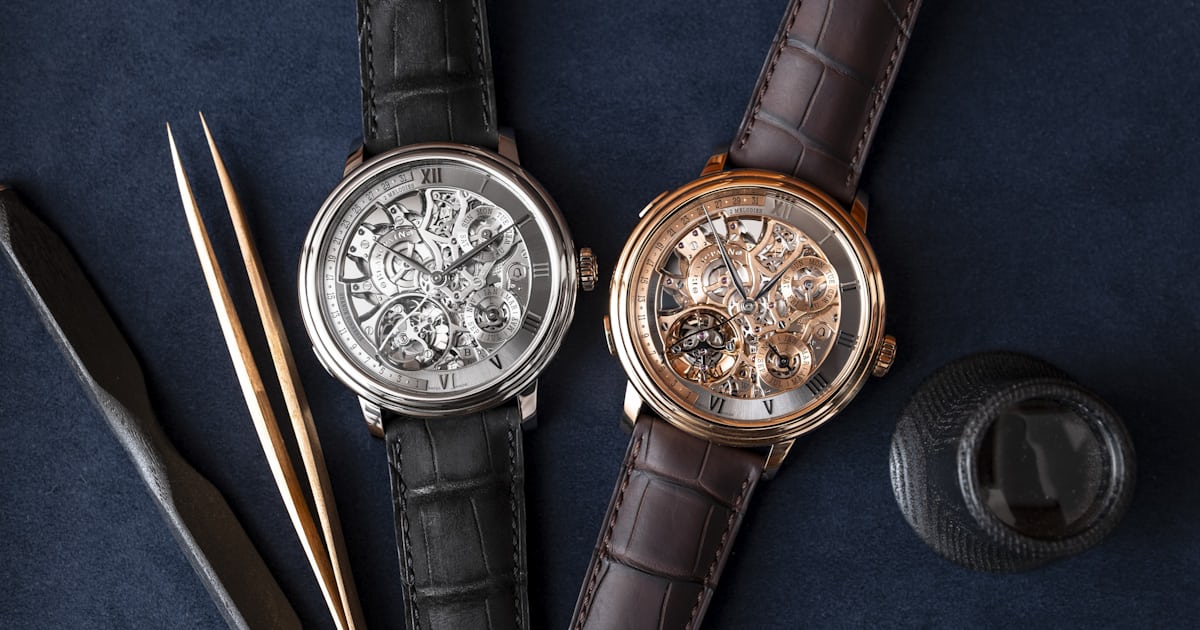
The result is a chiming watch that not only sounds the time in passage but does so using the world’s first dual-melody four-tone system, packaged inside a wearable 47mm gold case, assembled by just two watchmakers at a rate of no more than two watches per year.
What Is It?
For the spec-hungry among you, let’s start with the basics. The Blancpain Grand Double Sonnerie is an ultra-low-volume, largely handmade watch that has 1,053 components and measures 47 x 14.5 x 54.6mm. For the two examples already produced, the cases are made of either red or white gold with movement construction to match.

That said, the watch is a platform on which Blancpain can offer its best clients considerable customization, including alternative case and movement materials (and finishing) and even the possibility of a fully custom melody. The two examples shown in this story are meant to highlight a traditional execution of the form.
The 15GSQ is a manually wound movement that ticks at 4 Hz, has a power reserve of 96 hours for timekeeping and 12 hours of autonomy for the Grand Sonnerie, which uses a magnetic regulator.

A graphic of the 15GSQ and its stages of development.
From a complication standpoint, there is clearly a lot to explain, but here are the highlights:
- Grand and Petite Sonnerie
- Minute Repeater
- Dual Melodies: offering either Westminster chime or Blancpain’s own melody (this is user selectable with a case pusher that uses a column wheel to switch between the two four-note melodies)
- 4 Hz flying tourbillon
- Retrograde perpetual calendar with Blancpain’s underlug correctors.
- Dual rear power reserve indicators
What’s In A Note
Understanding the significance of this watch requires a bit of explanation for those who might not have spent much time around chiming watches. A minute repeater strikes the time only on demand, typically activated by a slide or pusher. It reads and mechanically interprets the time shown on the dial and chimes: hours first (low note), quarters (typically high + low note), then minutes (high note).
A petite sonnerie sounds automatically in passing, striking the hours and sometimes the quarters, but not repeating the hours each quarter. A grande sonnerie, however, sounds both the hours and the quarter-hours automatically as time passes. That means every 15 minutes, the watch audibly expresses the time without any action from the wearer.
Okay, Double It
In the traditional sense, most chiming watches have two notes, derived from two hammers that strike two gongs. To your ears, you’ll hear a low note and a high note. Usually, this will render as more of a chime than a musical experience. The Grande Double Sonnerie uses four distinct notes (E, G, F, B), with each note produced by its own dedicated hammer and gong. While yes, this is essentially double the hammers and gongs, there is a lot more to it, as the goal shifts from mere chiming (dings and dongs) to the rendering of a melody. This requires each note (gong) to be tuned to a specific frequency and to be played with precise timing (tempo).

An example of an unfinished gong.

The finished gongs for the Grand Double Sonnerie.

Examples of gongs made in other materials for testing.
Blancpain’s watchmakers used laser measurement to analyze the vibrations of the gongs (in several different materials during the development of the complication. The tolerances for note frequency are precise to the level of a professional instrument. In these images, you can see the red-gold gongs. Each gong is created, fully finished, and installed into a movement that is aligned with a special laser.
The laser measures the vibration of the gong, and the watchmakers are able to use that data to remove a tiny amount of material from the end of the gong to tune it for the exact frequency the note requires (see the chart below for both the key frequency and the additional resonant frequency). I got to try this myself, pressing the pusher to activate the hammer and watching a laser chart the gong’s travel.

The specialized jig that holds the finished gong while the watchmaker files off a tiny amount of material from the end to help tune the note the gong will produce.
Using the data from the laser measurement, they then use a special jig to finely shave the end of the hand-finished gong until it is perfectly tuned for the desired note.
So that’s how they make each note. But how do they play each note?
Two Melodies, One Switch
A grand sonnerie wristwatch with a distinct pair of four-note melodies that may seem like a stack of sub-qualifications looking for a world-first title, but from a watchmaking standpoint, it’s nothing short of massively complicated. Fitting a single four-note harmonic structure into the confines of a case already packed with a sonnerie mechanism, calendar system, and tourbillon is one thing; doubling it is another.

A diagram highlighting the melody selection (blue) along with the two melodies (pink and green).

A model of the system that coordinates the selection of the melodies, along with the notes and the timing for each.
The technical breakthrough is the use of a dual-layered approach to the pièce des quarts (also known as the quarter cam or quarter rack), the rotating mechanism that engages the hammers responsible for quarter-hour chimes. This component is essentially the “programming” for each note’s timing, with tiny teeth that load and release one of the four hammers. These teeth, which not only coordinate the note but also prescribe the tempo, are adjusted by hand using a microscope to ensure that the correct timing falls within a 1/10th of a second margin.
The Grand Double Sonnerie has two stacked pièce des quarts, one for the traditional Westminster melody, and the second for the “Blancpain melody” (which was actually created in partnership with Eric Singer, the drummer from Kiss, who is also a notable watch enthusiast and past Talking Watches guest). Singer worked with the keyboardist Derek Sherinian to develop a melody that would suit the watch and its mechanical capabilities. You can see the two melodies in notation below:


Adjusting the tempo of the notes.

The consideration of each note’s frequency.

The melody selection system in the movement of a finished watch.
This stack is paired with dual-level levées, which are the lever arms that interact with the hammers, and a column-wheel-controlled rocker enables the selection between them via a case-mounted pusher. This is displayed near six o’clock, with either a “W” or a “B” for each melody.

If set to the grand sonnerie mode, the watch plays either melody depending on the wearer’s choice at the quarter hour. At the top of the hour, the watch does something no other wristwatch grande sonnerie does: it sounds the hours, followed by the entire four-quarter sequence, effectively giving the watch its longest acoustic performance of the hour, not at 45 minutes, but at the hour itself.
Turn It Up
So we have an exceptionally complicated and impressively miniaturized system to create the correct note at the precise tempo prescribed by the melody. The next step is to make that melody as loud and as clear as possible, and for that, Blancpain has two notable (and patented) systems at work.

The magnetic regulation system that controls the power delivery to the chiming mechanism.
The first is the use of a magnetic regulator. Similar to that seen on the Breguet Classique La Musicale, this system helps, well, regulate the power from the spring barrel, which powers the chiming complication. On traditional chiming watches, the regulation often creates a buzzing sound that is noticeable between each note of a given chime. For the Grand Double Sonnierie, the magnetic regulator uses magnetic resistance, which is both silent and up to 50% more efficient than conventional regulators.
The second is a novel acoustic membrane that is mounted under the bezel of the Grand Double Sonnerie. This patented system uses a tiny ribbon of red gold that acts as a resonant membrane to help vibrations transfer from the midcase to the bezel of the watch. To put it simply, the system allows the bezel to vibrate along with the membrane, acting a bit like a tiny speaker. Blancpain says this helped to create both a warmer sound and a more accurate amplification of the lower frequencies.

An expanded diagram of the acoustic membrane, seen in pink.

A macro shot of the membrane in the structure between and case and bezel.
Speaking of amplification, the Grand Double Sonnierie is delivered in a special resonant box, making it easier to share the sound with an audience. The box is made from wood from the Vallée de Joux’s Risoud forest, a wood sometimes used to make instruments such as violins. The watch rests on a floating plank over a shaped platform meant to amplify the sound.
Hear It Play
I suppose that if you’ve read this far, you’d like to hear the dang thing play the two melodies. Here you go, the first video is the Blancpain melody, you can see the “B” on the dial near six o’clock. The second clip is the Westminster melody, denoted by a “W”. If your browser autoplays the video, just click the symbol to unmute.
To my ears, the two melodies sound very similar, but that isn’t especially surprising as they share the limitation of the same four notes and the same time signature. For those curious, each melody is shown above in musical notation (just scroll up).
Beyond The Melody
As mentioned well above, this is not only a watch with a novel dual-melody four-note chiming system, but also offers a perpetual calendar and a flying tourbillon.

The front of the Grande Double Sonnerie offers a view of its many complications.
While QPs are, of course, expected in grand complications, Blancpain went a step further by fully integrating the calendar complication into the movement. This complicated decision was made to keep both as thin as possible and also to ensure that the bridge for the QP would not block the open-worked view of the chiming complication while the watch is on your wrist. As such, the perpetual calendar function is supported by the skeletonized, fully hand-finished single mainplate, which you can see on the right side of the watch’s front view.

The date display for the perpetual calendar.
From a display standpoint, the retrograde date is shown along the outer left side, while day, month, and leap year are shown using two apertures on the right. Interestingly, Blancpain’s patented under-lug correctors had to be re-engineered due to the acoustic membrane.
This meant that the return spring for the underlug system had to be integrated into the movement itself, rather than in the case. On the whole, the movement has five separate safety systems to prevent damage to the movement through midhandling of the crown or correctors.

A closeup shot of the flying tourbillon.
As if that wasn’t enough, let’s not forget the flying tourbillon. A signature of Blancpain’s complicated watches, the brand introduced the world’s first flying tourbillon for a wristwatch in 1989. In the Grande Double Sonnerie, Blancpain updates this core technology with a silicon balance spring. The tourbillon’s spinning animation is surrounded by a host of polished surfaces that ensure ample light enters the cage, highlighting the complication.
Hand Finished And Hand Built
As part of my tour of the Blancpain workshop responsible for the Grand Double Sonnerie, we had the chance to visit with the small team of watchmakers tasked with finishing the movement to the highest of Blancpain’s standards.

A Blancpain finisher inspects the mirror polish on a hammer.
With 1053 components, including a gold skeletonized mainplate and some 26 gold bridges, Blancpain’s finishers work on every surface of every part. As is common with Blancpain’s watches, every component is finished on both sides, even when it won’t be visible to anyone other than a watchmaker.
Blancpain was quite proud of the interior anglage, which spans some 135 inward angles, all finished by hand using a process that includes carving, wood polishing, and gentian stem burnishing, which is a technique developed in this region of Switzerland and uses gentian wood, which is collected by the watchmaker in the outlying areas of the facility in Le Brassus.

The tools of the trade, including gentian wood, which is sharpened by hand to aid in anglage and polishing.

Three hammers set for polishing.

The fine hand perlage of a bridge.
For a watch from a major brand, the finishing is remarkable. Four sizes of perlage are used, including one that calls for a bespoke tool crafted by hand. For the Côte de Genève finish, artisans forego abrasive papers in favor of working with carbon stone, applying each stripe in up to five carefully controlled stages.

Applying the Côte de Genève finish.

Hand perlage in action.

Using the gentian wood on the interior anglage of the perpetual calendar bridge.

Once you have all of the parts (and all of those parts have been finished), it’s time to build the dang watch, which is a task for Romain and Yoann, the only two watchmakers at Blancpain who will build the Grand Double Sonnerie. Both watchmakers have been with Blancpain for more than 10 years, and both have spent the bulk of their careers focusing on the design and assembly of chiming watches.
Each watch requires approximately twelve months of assembly, from start to finish, undertaken by a single watchmaker. When complete, the maker engraves his name on a gold plaque mounted to the movement. Given that a given watch takes roughly one year to complete and only two staffers can put it all together, it’s not hard to see how Blancpain reached its production limit of two watches per year.

Elements of the assembly for the 15GSQ movement.

Jigs, tooling, and more.

An array of tiny springs ready for assembly.

A partially assembled tourbillon.

Parts, parts, and more parts.

A movement in a phase of assembly, showing a partial dial iteration of the Grande Double Sonnerie’s front view.

A finished case.

Inspecting and adjusting the teeth that activate each note at the precise moment requires micron-level adjustment with the aid of a microscope.

A magnified view of the signed name plates that are fitted to the back of the final movement.
I had a chance to briefly meet the assembly team and see the collection of specialized tools, multicell trays of tiny components, and massive binders that describe each step in the assembly process. It’s a dizzying process to imagine, and many of the steps require a microscope to ensure proper completion. If you’re wondering how Blancpain arrived at the Grand Double Sonnerie’s suitably grand pricetag, you have to factor in the time and knowledge invested into the finishing and assembly process.
The Grand Double Sonnerie As A Watch
So there you have it, many, many words about notes, melodies, calendars, tourbillons, finishing, and assembly. The creation of this watch is nothing short of intense. An eight-year study into what is possible that rendered a watch that takes an entire year to make. Oh, and you have to spend CHF $1,700,000 (inclusive of tax) to get your name on the list for a future build. But don’t forget that much of the watch is customizable, including the melody. No, I don’t know what a custom melody might add to the price tag.

Watches such as this are a different sort of thing to write about, because they barely represent a commercial product. There are cars, and then there are Bugatti Veyrons, and it doesn’t make a lot of sense to try and “review” a Veyron the way one might review a more conventional mass-market vehicle. In this specific example, it’s hard to believe it’s exclusively about the ~20 watches that Blancpain may produce in the next decade. It’s more about an exercise in establishing brand position and not giving up a space in the conversation surrounding ultra-high-end watchmaking.
This watch is a flagship in the truest sense, a way for Blancpain to highlight its capability and prowess while offering something truly special to its most adent clientele. The fact that this is far from my sort of watch is largely beside the point. I did, however, love to see Fifty Fathoms on the wrists of most of the watchmakers and engineers who helped explain many of the technical elements outlined above. But I’ve digressed, let’s consider this peak Blancpain as a whole, as a watch.


As mentioned long ago, the Grande Double Sonnerie measures 47.0 mm in diameter, 14.5 mm thick, and 54.6 mm lug-to-lug, with the specific goal of creating a watch that still offers a wearable experience for the owner. While indeed not a small watch, I have to give credit to Blancpain for the packaging, as the watch sits well, and it’s remarkable that they’ve been able to package so much complication into a watch that is less than a millimeter thicker than a conventional Speedmaster.
Let’s not forget the dimensions of other highly complicated chiming watches, such as the Patek Philippe Grand Master Chime 5175R (47.4 x 16.1mm), the A. Lange & Sohne 1815 Grand Comp (50 x 20.3 mm), or the Omega Chrono Chime (45 x 17.3mm). Among its most direct competitors, the Grand Double Sonnerie has more chiming capability and does so with a slimmer profile.


I’m not going to tell you that it wears smaller than you’d think. It sits like a full-size Luminor and has a presence befitting a watch with more than 1000 components. That said, they shot for “wearable,” and I think they met that goal, especially for a watch that is unlikely to be anyone’s daily. That said, you do you.
On wrist, the watch feels heavy and very well made. The pushers are firm and crisp, requiring more effort than I expected, especially to switch between the two melodies. The detailed finishing catches any available light, and the tourbillon remains brightly lit and easy to enjoy. The calendar display is easy enough to track after a few minutes to familiarize yourself, and the main time display is there when you need it, but feels largely designed to avoid pulling attention from the broad display of the skeletonized movement, the four hammers, the tourbillon, and the icons for the melody selection and the chiming settings.

The dial-side (though there is no traditional “dial”) is quite busy but limited in terms of text. You have a half-set of Roman numerals for 12-6 on the right perimeter, and the retrograde date on the left. “Blancpain” has been engraved into the bridge surrounding the four mirror-polished hammers, which is perhaps my favorite part of the front of the watch.
Take it off your wrist and flip it over to see a bright, welcome display of the mechanics for the grand sonnerie, as well as a pair of retrograde power-reserve indications. One for the timekeeping and one for the chiming function. You can see the pair of barrels for the power reserve and the small Blancpain plate, on the back of which is the watchmaker’s name.


If you skipped it above, there is a video of how it sounds playing both the Westminster chime and the Blancpain melody from the model with the white gold case. Both are clear and musical, and, even as a knucklehead who loves titanium dive watches and is mostly used to the hourly chime of his Timex Ironman, it’s a delight to see the hammers load and play each note in the melody.
What Does It Mean For Blancpain?
To close out a very long and complicated introduction, I think it’s interesting to consider what this watch might mean for Blancpain. From an audience perspective, the past few years at Blancpain have been primarily focused on the Fifty Fathoms, and, by extension, the Scuba Fifty collaboration with Swatch.

Traditionally, Blancpain has been known as a brand that can do both. Both high-end dive watches and ever-higher-end traditional complicated watches. I think it’s noteworthy that, as the brand revamped the Fifty Fathoms, celebrated the 70th anniversary of its dive watch, and worked with Swatch to make a sub-$500 version, they were also toiling away on a watch meant for an entirely different audience.
The result is the brand’s most complicated and highly finished watch in an era when time-only offerings from popular independents trade mechanical complexity for hand-finished simplicity. For Blancpain, it doesn’t seem they wish to make the same trade. Furthermore, let’s not forget that this watch represents a credible and noteworthy evolution of a very respected complication, the grand sonnerie wristwatch, which was first created (in a wristwatch) in 1992 by Philippe Dufour, who is based less than 10 minutes down the road from where Blancpain is creating the Grande Double Sonnerie.
Credit where credit is due, this watch represents a big move for Blancpain in the haute horology space, and given the connection between Blancpain and Breguet (Marc A. Hayek is the CEO of Blancpain and the President of Breguet, Glashutte Original, and Jaquet Droz), 2025 has shaped up to be a banner year for high-end watchmaking from these two legacy brands within the Swatch Group.

From thousands of Swatches to a seven-figure watch that took eight years to create and a year more to actually make each example, maximalism appears to be the strategy for Blancpain, and the Grand Double Sonnierie underlines the brand’s continued work in a style of watchmaking that combines cutting-edge processes with traditional complications and no small measure of handcraft.
Source: www.hodinkee.com — original article published 2025-11-24 09:00:00.
Read the full story on www.hodinkee.com → [source_url]