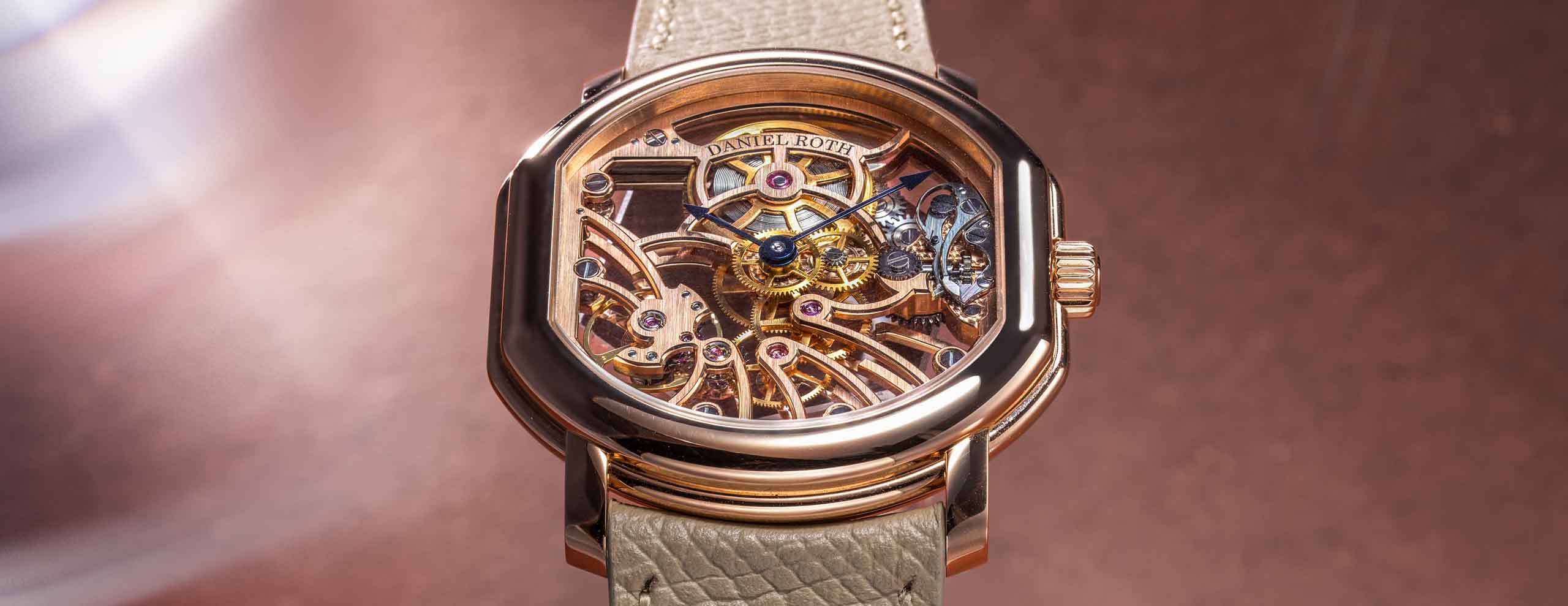
Editor’s pick — Accessory quick take: key highlight (movement/specs for watches, materials/finish, limited run, pricing tier) in 1–2 lines.

The beautiful, brushed dial is catching the light perfectly, creating a subtle sunburst effect as a simple spar sweeps round to 12. Not 12 o’clock, but a 12 set at 1 o’clock. A crucial 12, though, because it marks the time to change. It signals the zenith of a screaming crescendo that began mere moments ago when the needle flicked back like a retrograde reset, before beginning its climb once more. The twelve is actually 12,000, and the dial is connected to the revolutions per minute of the incredible 3.9-litre V12 engine just behind my tingling spine in a GMA T.50.
12, lift, clutch, shift, clutch, throttle. But performed in a syllable, not a sentence.

The central tachymeter of the wildly fast-revving GMA T.50.
I can’t say I’ve ever louped the dial on a dashboard, but I have stared pretty intently at a few over the years. Yes, there are often clocks in cars (and some interesting ones at that), but it’s always been the gauges for speed, revs, boost, etc that have captured my attention in something akin to the way watches have also fascinated me.
When I was young, it would sometimes be the wonder of peering in through a window to see a speedometer where the numbers went all the way up to 180 or even 200mph. I loved Ferraris as a small boy (red was my favourite colour), and I still remember the wonder of seeing the vibrant, almost Day-Glo orange of the text and needles contrasting against the otherwise black Veglia dials in a Testarossa. More prosaically and regardless of what you drive, I’m sure most of us have been transfixed at one time or another by the automotive equivalent of a mainspring power reserve indicator. There are few sweeter reliefs in motoring than finding a fuel station when the needle has been resting on the post for the last few miles. And I can’t be the only one who has tried to fathom whether or why a particular needle seems to drop at varying rates in its sweep from full to empty. Or Auf to Ab.

The blued instrument cluster of an Alpina BMW.

The tach on a 1933 Bentley raced by Eddie Hall (solo!) at Le Mans.

The aviation-inspired gauges of a Rocketeer MX-5.
When I started out as a motoring journalist, we used to do a lot of testing to see how the car manufacturers’ claims for acceleration, top speed, and braking stood up to scrutiny. This involved going to a proving ground, such as Millbrook or MIRA, and performing some pretty brutal procedures that most owners would never carry out in their own car. These days, with launch control and usually just two pedals to worry about, it’s all much easier, but back then, it was often a tricky balancing act juggling biting points and throttle inputs.
For a standing start, you needed to get a feel for just how many revs each particular car required, and it could be a matter of a mere hundred between success and failure, between the engine bogging down and the tyres vaporising themselves in a Ken Block cloud of smoke. I can remember sitting on the start line desperately trying to finesse my right foot’s inputs, calf muscle taught, toes tensed, while willing the needle on the rev counter to stop wavering and just hover over the correct number before dumping the clutch.

The cockeyed layout of the Audi Sport Quattro S1 Evo Group B rally car.
If you managed to nail it, you’d feel the perfect amount of slip and grip twixt tread and tarmac underneath you, but there was never time for celebration because you’d then have to concentrate on the red line. First to second gear is often tricky for a number of reasons, but mostly because the revs also accelerate as they build, and the needle is often moving so fast in first that you need to pre-empt the shift. Too early and you’ll know you haven’t maximised the car’s potential performance. Too late and you’ll hit an electronic brick wall, and as you enjoy some mild, admonishing whiplash from the limiter, you’ll know that aborting the run is the only option. Get it just right, shift just as the point of the needle dips into the red paint, and it’s as satisfying as a bezel rotated swiftly to the precise click intended.
I’ve tried hard not to be transfixed by speedometers over the years as well. When hunting a high speed on an autobahn in Germany or a disused runway like Bruntingthorpe (a former Strategic Air Command bomber base in the UK), there is always that temptation to get mesmerised by the sweep of the needle towards a particular number. Your gaze can become focused on the dial instead of the more important task of watching the world rush towards you at three miles a minute or more. At least with an analogue dial, there is a nice bit of wiggle room, and sometimes a lack of legibility can even be a boon – you can back off knowing it was around 200mph, your conscience clear as you retell the story later. Digital readouts are so dastardly definite.

The iconic gauges of the McLaren F1.
Of course, some dials do make things easy to discern, and others are as baffling as an 806 Navitimer when you first clap eyes on them. One of the clearest sets of dials can be found in the GMA T.50’s spiritual predecessor, the McLaren F1. The black text on a pure white background is mesmerising in its stark simplicity. The speedo to the right is obviously fabulous for the fact that it goes all the way to 260, but the rev counter is unusual in that the thousand rpm increments are labelled in their full four-digit forms from 1000 to 8000, each one at the end of a slender spar on a very sparse (and obviously incomplete) chapter ring.
Just as with watches, a good dial design is not solely the preserve of the monumentally expensive, however. The Peugeot 205 GTi always sticks in my mind as having a set of dials as strikingly simple and pleasing as a good field watch. Equally, its Gallic rival, the Renault Clio Williams, showed how elevating a dash of colour could be with its blue-hued faces.

E46 BMW M3 gauges (photo courtesy of Thomas Holland).
Another that always sticks in my mind is the rev counter in the E46 generation of BMW M3. Sink into the bucket seat and through the Alcantara-clad wheel, you’d see a set of fairly demure grey dials with relatively small white writing and long orange needles. Start the car from cold, however, and a series of squares would illuminate – an octet in yellow from 4 to 8 and then two red above 9.
These were a reminder that you weren’t in any old 3-series, you were in control of a magnificent S54 straight-six engine that needed warming gently. As you covered the first miles and the oil warmed, the lights would be extinguished, giving you permission to venture ever further up the rev range and hear more and more of that M3’s fabulous induction bark.
On a similar but more prosaic level, the Mk4 Golf (engine type and displacement unimportant) was always a favourite for the way its dials glowed with a blue backlight. Those on the Mk3 Golf had, like its predecessors, been lit often quite dimly from the front. The Mk4 was like a hit of Superluminova BGW9 after years of faded Radium lume.
The 1960s Volvo P1800 has a set of dials with incredible depth and almost unnecessary beauty. Reading the revs and speed from the revolving drums in a 1970s series 1 Citroen CX is like telling the time on a M.A.D.1. The Audi Quattro and Nissan 300 ZX both deserve mentions for their fabulous fully digital dashes; they’re all the reasons I love a classic Casio.

The backlit beauty of the gauge pack in a Volvo P1800.
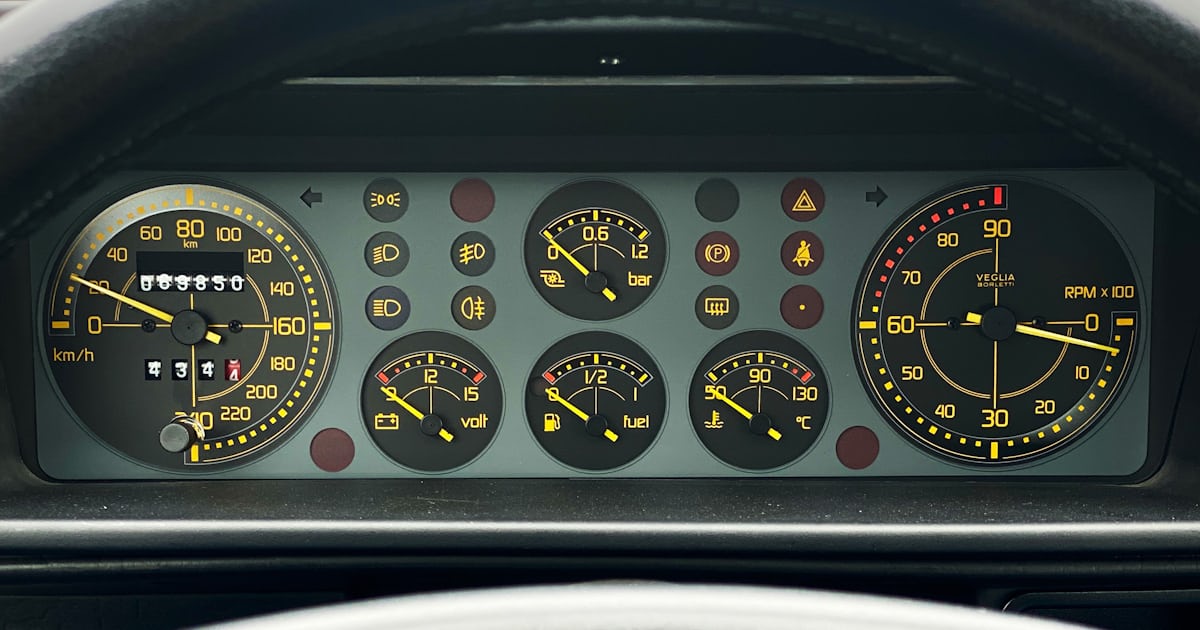
There are some awful ones, too. In contrast to the previously mentioned French fancies, my own Renault Clio 182, much though I love how it drives, has text on the dials that appears to be a second cousin to Comic Sans. It makes a Flik Flak look MIL-SPEC. The Lancia Delta Integrale (seen in the lead image) is iconic, but the chaotic cluster of gauges is almost overwhelming when you glance down at them, hoping to pick out some information. Individually, I love the sector dial style with the pips or plots round the edge, but as a collective, it’s too much.
One of the names it’s always nice to see on a dial is Smiths. Yes, they of the De Luxe fly in the Explorer’s Everest advertising ointment. Nicole Nielsen, who in the early 20th Century was making many of the best Smiths watches for the admiralty, also designed the first Smiths speedometer, known as the Perfect Speed Indicator. Snappy. The building where they were subsequently made still exists on Great Portland Street in London and is called, predictably, The Smiths Building, but at the time was anointed, rather more excitingly, Speedometer House. Today, Smiths dials are all made in South Wales, close to some of the best driving roads in the UK.

A Smiths tachymeter from a Jaguar XK120.

A Smiths speedometer from a Jaguar XK120.

A Smiths dual temperature gauge from a Jaguar XK120.
The other familiar name often seen on classic dials is Jaeger, and it is indeed the same J that is on a Jaeger-LeCoultre Reverso. Jaeger made instruments for Allied planes during WWI and then transferred this expertise to automobiles in the years afterwards. However, the Speedometers etc weren’t made in France or Switzerland but by a separate company that Edmond set up in 1921 in Britain, called Ed. Jaeger (London) Ltd. Three-quarters of that company was then sold to… Smiths in 1927, but the two names continued separately, occasionally even both appearing in the same car.
And Jaeger dials hold a special place in my heart because they were in two cars that are similar in age, but which came into my life about 30 years apart. When I was still in short trousers, I used to stare at a beautiful but inert Jaeger dial while I was pretending to drive a 1955 MG TF 1500 that belonged to my mother. She had owned it since she was a girl about town in her early 20s but it had been put up on bricks in a barn long before I was born and so I used to brave the cobwebs and sneak onto the cracked leather of the driver’s seat (oh that vintage smell!), smear the dust off the Jaeger dials – octagonal in shape to match the MG badge – and wield the big steering wheel pretending to race competitors unseen. When I could eventually reach them, I’d work the pedals too.

Mother Catchpole’s MG TF 1500.
Many years later, I found myself behind an equally large, thin-rimmed wheel with another set of gorgeous white-on-black Jaeger dials in front of me. But this time it wasn’t so much a case of reaching the pedals as remembering what they all did, because the car in question was a 1958 Le Mans-winning Ferrari Testa Rossa (two words this time) and it had a centre throttle. Imagine being handed, say, Buzz Aldrin’s Speedmaster and then being told to time a race with it, but then also being informed that the pushers have had their functions swapped over from what you’ve always known. The mixture of joy, reverence, and terror was something akin to that drive in the Ferrari. I’ve never concentrated so hard.
Modern Ferraris, sadly, pale next to either TR when it comes to dials. But they are not alone. In recent years, it feels like the performance car industry has been going through something of a quartz identity crisis. The mega-Watt EV has been kicking sand in the face of the traditional internal combustion engine supercar in terms of pure numbers. And yet it turns out that customers want more than just the equivalent of very accurate timekeeping; They want emotion and beauty and individuality.

The very horologically-inspired clockfaces of the Bugatti Tourbillon.
And that same sentiment applies on a more specific level to the cockpits, too. Touchscreens and digital displays have become the norm, but just as I suspect you prefer the feel of winding a crown to swiping a screen, so drivers would rather adjust with something tactile (regardless of the actual ease of use, which is another story).
Aston Martin is leading the charge with some beautifully knurled and weighted switchgear, and Ferrari has also seen sense and returned to a physical Start/Stop button. I think that digital dashes will remain in vogue a little longer, but (appropriately) the new Bugatti Turbillon is already showing the way forward with a set of rather striking skeletonised dials that openly pay tribute to the world of haute horology.

The gauges of a TVR Tuscan.
So, hopefully I’ll continue to find fascination in dials for many miles to come. Whether it’s new numbers on a speedo, the particular liveliness of a boost gauge, the terrifying telltale on a historic race car tach, the tryptic revealed by the revolving Toblerone of wonder in a Bentley, or a glovebox of gauges in a NISMO 400R.
And I haven’t even mentioned TVRs so that I can make my Tuscan dial joke. Probably for the best.
About The Author
Henry Catchpole is a British automotive journalist, presenter, and driver, celebrated for his eloquent storytelling and deep technical expertise with high-performance vehicles. Known for his tenure at Evo magazine and later Carfection, his reviews are marked by their poetic tone and precision behind the wheel. Today, he is a prominent host for Hagerty’s YouTube channel, where he blends enthusiast passion with expert insight while exploring everything from modern hypercars to motorsport icons.
Source: www.hodinkee.com — original article published 2025-11-26 16:00:00.
Read the full story on www.hodinkee.com → [source_url]