
Editor’s pick — Accessory quick take: key highlight (movement/specs for watches, materials/finish, limited run, pricing tier) in 1–2 lines.

Ferdinand-Adolph Lange died 150 years ago this year. The name should be familiar, as the man’s watchmaking would go on to shape a sleepy town in rural Germany and the broader world, even to this day. For all the attention on Swiss watchmaking, the horological world has always been wider than one country could bear, and Glashütte’s watchmaking minds have never stopped going punch-for-punch with the best anywhere. As evidence in the metal, Dr. Helmut Crott, whose knowledge frankly knows very little bounds and curatorial and collecting skills put him up with the best in the world, has put together a traveling exhibition of Glashütte’s best. Curated by the man himself and put on by Phillips, the watches come from Dr. Crott’s personal collection and represent a broad range of the A. Lange & Söhne and the wider town’s story.


A 1921/1931 Bruno Reichert Flying One-Minute Tourbillon Up/Down Pocket Watch with chain-and-fusee and a tiny planetary gear inside the fusee.

A. Lange & Söhne’s 1990s Tourbillon Pour le Mérite was the first wristwatch powered by a chain and fusee. Inspired by the Reichert pocket watch seen here, it also incorporated a planetary gear inside the fusee.
It’s a rare treat to see a collection like Dr. Crott’s. The man has a fascinating history with Glashütte watchmaking, which he recounts in an essay over on Phillips’ website. In short, while pursuing a nascent idea for a specialized watch auction house, he turned to a friend and former schoolmate, Richard Miklosch (1939-2014), a self-taught watchmaker known for Glashütte-style pocket-watch tourbillons. Miklosch showed him a flying tourbillon pocket watch from Max Hahn, made in the 1930s, and his passion flourished from there.

A circa 1820 Johan Christian Friedrich Gutkaes Pocket Watch No. 9.


I won’t go any further recounting Dr. Crott’s story. The essay is well worth the read. What I will say is that after missing the exhibition in Geneva (though James Stacey attended and shared these photos), I was quite disappointed that I might never see these watches. Collecting watches isn’t just about owning an object; it’s about acquiring knowledge through in-person experience. It’s also about knowing who you are and what you care about, and this collection represents a focus that few collectors can claim to have in the modern era.

A unique circa 1911 A. Lange & Söhne Grande & Petite Sonnerie Pocket Watch No. 62510 with minute repeater and mineral glass dial and caseback.
Pieces like the A. Lange & Söhne Grande & Petite Sonnerie pocket watch (with minute repeater) from around 1911 is an incredible representation of not just technicality but craft, using a mineral glass dial when few brands would dare. Chronometry was an equal (or maybe even greater) focus in Glashütte, with watches like the A. Lange & Söhne Half-Second Chronometer Deckwatch No. 92307 with Glashütte pivoted detent escapement and power reserve indicator, and the Hans Carl Conrad Flying One-Minute Tourbillon are both must-see watches. Then there are the complicated pieces, which round out a collection dating back to 1845.


Luckily, the exhibition is coming to New York next week, and so not only will I be able to catch up with what I missed in Geneva, but anyone else in the city can as well. The exhibition is open from 10:00 AM to 7:00 PM on December 3-5. For more information, visit Phillips’ website.
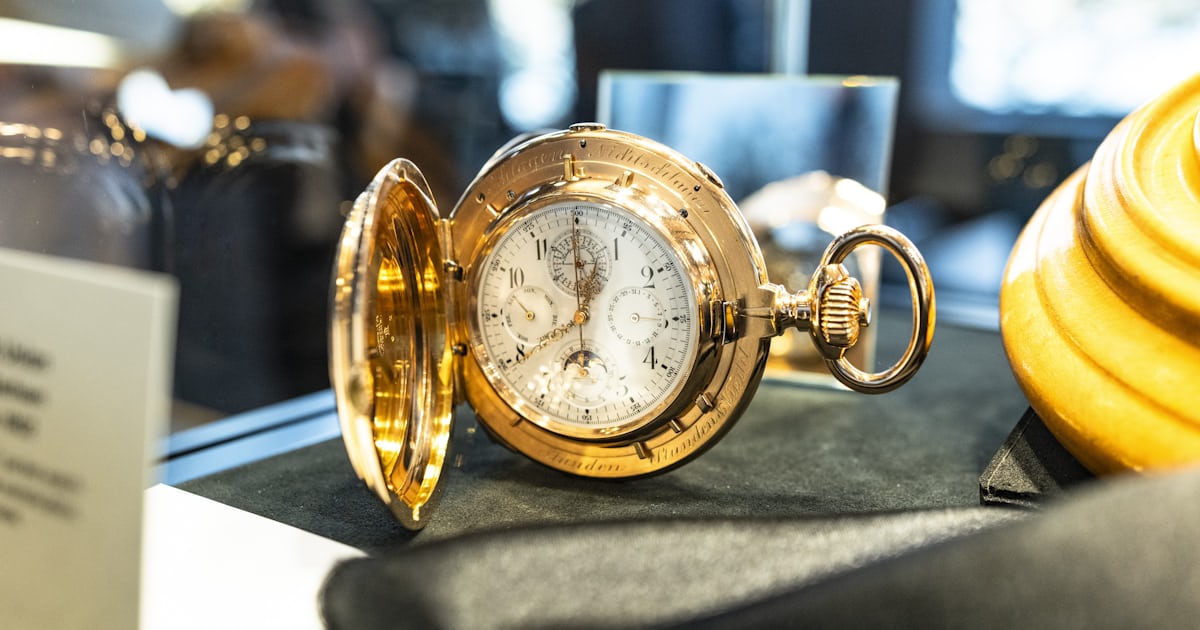
Lead photo of a circa 1902 Uhrenfabrik Union Grande Complication Pocket Watch No. 44502 with Grande and Petite Sonnerie, Minute Repeater, Split-Seconds Chronograph, and Perpetual Calendar. Only six Grande Complication watches were ever completed by Union Glashütte.
Source: www.hodinkee.com — original article published 2025-11-27 16:00:00.
Read the full story on www.hodinkee.com → [source_url]