Editor’s pick — Accessory quick take: key highlight (movement/specs for watches, materials/finish, limited run, pricing tier) in 1–2 lines.

The GMT complication is a popular one. Whether it’s a flyer or a caller-style GMT, the tracking of an additional time zone or two is one of the more utilitarian complications in watchmaking. But despite its fanfare and love from the community, there are folks out there who find what is supposed to be an all-encompassing travel watch absolutely useless. No, I’m not talking about people too lazy to pull out a crown or to read a bezel. I’m talking about people living in countries that use thirty or forty-five minute offsets to Coordinated Universal Time (UTC). And it’s not just remote, faraway lands, either. This includes the most populous country in the world, India, with its thirty-minute offset. Many other areas also have this thirty-minute offset, including Newfoundland (that’s in Canada), parts of Australia, Sri Lanka, and more, while New Zealand’s Chatham Islands and parts of Australia rely on a forty-five-minute shift.
For Nava Krishnan, a watch collector who grew up in India and now lives in Washington, D.C., the inability to track his family’s time zone on his conventional GMT watches had been a long-standing frustration. So Krishnan decided to take this matter into his own hands, and, after many years of design and prototyping, he thinks he’s cracked the puzzle.


This is the Delta Type, the first watch to come from his new brand, Ardra Labs. Swiss-made and priced at $2,450, it’s a caller-style GMT watch with a unique design that can simultaneously indicate time in any two time zones on Earth, including those thirty- and forty-five-minute offsets. What’s most impressive is the simplicity of Krishnan’s solution here, powered by one of the most ubiquitous GMT movements on the market—the Sellita SW-330.
The genius here is in its patented “PAN-GMT” display, offering a unique way of displaying the time(s). The granted utility patent covers the entire architecture of the time display: a multi-vertex minute hand, a multi-indicator 24-hour GMT hand that corresponds to those vertices, and their rotational relationship via the conventional 1-hour and 24-hour wheels. Long story short, the patent illustrates Krishnan’s ability to display all of this additional information while still relying on a traditional GMT caliber.


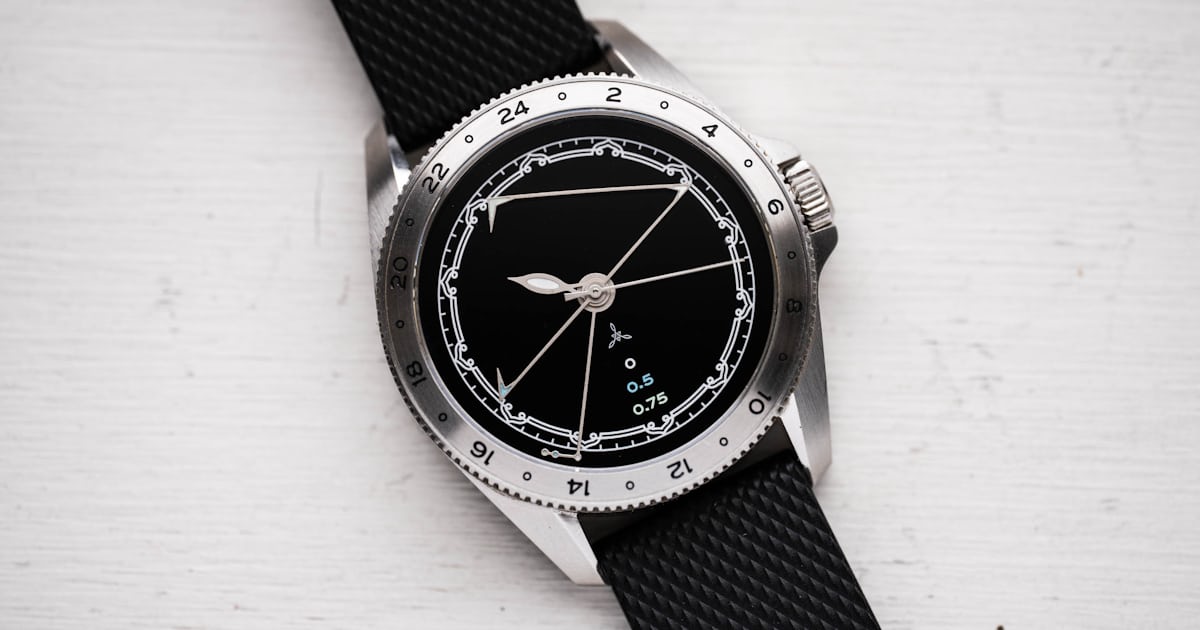
The main hour hand is conventional, while the multi-vertex minute hand immediately stands out. It’s really three hands in one, with a unique V-shaped design that points to three parts of the minute track simultaneously. The corner of the “V” indicates the standard minutes, while the arrow filled with blue Super-LumiNova is offset by thirty minutes, and the largest arrow filled with green shows that forty-five-minute shift. If you forget which arrow points to what, a colored scale printed at six o’clock on the dial reminds you which color indicates which offset. This color scale also applies to the GMT hand, which is reverse-L shaped with additional pips filled with the same colors of Super-LumiNova. This allows for the correct hour reading on the bidirectional, 120-click GMT bezel with a circularly brushed insert.
All of the Super-LumiNova felt quite uniform on the handset, even though it’s hand-applied, a great detail for a microbrand’s first entry. The hands sit atop a deep, glossy black dial, with the Ardra Labs logo printed above the colored (and lumed) scale for the time shifts of the minute hand(s). The minutes track features an incredibly tastefully executed decorative motif that draws on Krishnan’s Indian heritage and inspirations. It’s a great example of restraint in the design, with enough whimsy here to complement the unconventional handset, but nothing more.

I’ll be honest—when I first received photos of the Delta Type, I thought the minute hand would be an absolute headache to read. But immediately after getting the watch in person and Krishnan explaining to me that the vertex of the open triangle was the main minute reference, I never again found telling the time an issue. In fact, this minute hand design is theoretically even easier to read than a conventional one, given the sheer size of the leading lines that point to the information needed. In addition to legibility in the daytime, at night, the corresponding colors of the shifts are preserved in lume, while the decorative portion of the minutes track is also lit up. One nitpick here is that I’d wish the entire minutes track and the bezel numerals were lumed, adding to the practical utility of it all.
Turn the watch overand you’ll see an exhibition caseback that gives a view of the Sellita SW-330 automatic movement, with a 56-hour power reserve. It is a very standard view from many a watch, but the custom-engraved rotor is well-designed. As the watch I handled was a years-old prototype, the caseback reads “Patent Pending,” though thanks to the now granted patent, production models will have a caseback that reads “Patented” (and will be a lot cleaner than the caseback shown in my photos).


The Delta Type features a 316L stainless steel case measuring 39mm in diameter, 11mm thick, and 47mm lug-to-lug. While the case silhouette remains classic and simple, a closer look reveals some nice touches, including polished facets on the inner lugs and a nice recessed line engraving on the case sides. While the dimensions seem very classic on paper, the Delta Type wore a bit larger than expected, most likely due to the lug proportions and the polished slab sides of the case.
But it’s still a comfortable watch, and thanks to its 100 meters of water resistance and rubber strap, it is a good option for those looking for the most comprehensive GMT complication while being a worry-free everyday watch. To be completely honest, the rubber strap, while versatile, feels like a bit of a clunky afterthought—the lack of taper and a generic polished buckle that doesn’t quite match the case’s execution are the big culprits here. But thankfully, it’s the one part of the watch that you can change, and I’d certainly swap this for any of my other 20mm straps immediately.

While a SW330-powered caller GMT, priced around the $2,500 mark, squarely eliminates it from any “value-proposition” talk in the most conventional sense, the Delta Type offers an alternative proposition—a unique take on the GMT that’s protected by the patent. After spending a week with the Delta Type, the watch still feels delightfully original in both concept and execution. Very few options remain as true alternatives that tell both minutes and hours in an offset time zone, with the main one that comes to mind being the Glashütte Original Senator Cosmopolite. Yes, it is a much more mechanically sophisticated watch, but the German alternative is 44mm in diameter and priced at $24,700 on a strap, making the Delta Type much more appealing to a much broader audience.
The Delta Type is being produced in a limited series of 300 pieces. Krishnan tells me that there will be more variations to come, but for now, the brand is starting small. It’s a strong start for a promising brand that has the passion of a smart collector behind it, and if this is its first entry, I think the future is bright.
For more, visit Ardra Labs.
Source: www.hodinkee.com — original article published 2026-03-02 16:01:00.
Read the full story on www.hodinkee.com → [source_url]