Editor’s pick — Accessory quick take: key highlight (movement/specs for watches, materials/finish, limited run, pricing tier) in 1–2 lines.

If I had to make a short list of brands whose releases I’ve been tracking the past few years, Daniel Roth would be near the top. An “Extra Plat” in white metal (which doesn’t currently exist) would fill a conspicuous void in my collection where a dress watch would sit, and a man can dream.
My interest in Roth stems partly from the fact that the company, run by La Fabrique du Temps Louis Vuitton, has turned a potential limitation into a strength. Maybe I’m too much of a traditionalist or conservative—I like things that feel comfortable and get stronger through refinement, not through reinventing the wheel or giving dozens of options. A Royal Oak. A Patek ref. 96 or 3796. A two-tone silver or galvanic black dial on a vintage chronograph. I don’t have particularly outlandish taste. So it doesn’t bother me the way it seems to really irk others if a brand uses its best design across many models.

The same goes for Daniel Roth. In the brief time Mr. Roth himself owned the company (from 1988 or so to 1994), he set clear, defined design guardrails, made what are now considered iconic and comfortably wearable pieces, and, in unfortunately short order, his eponymous company was out of his hands. While others later experimented with what the Roth brand could be, I think it became clear that Daniel Roth is best in its limited format: that simple, refined double-ellipse, or “Ellipsocurvex” shape and classic dials. And that’s fine by me.
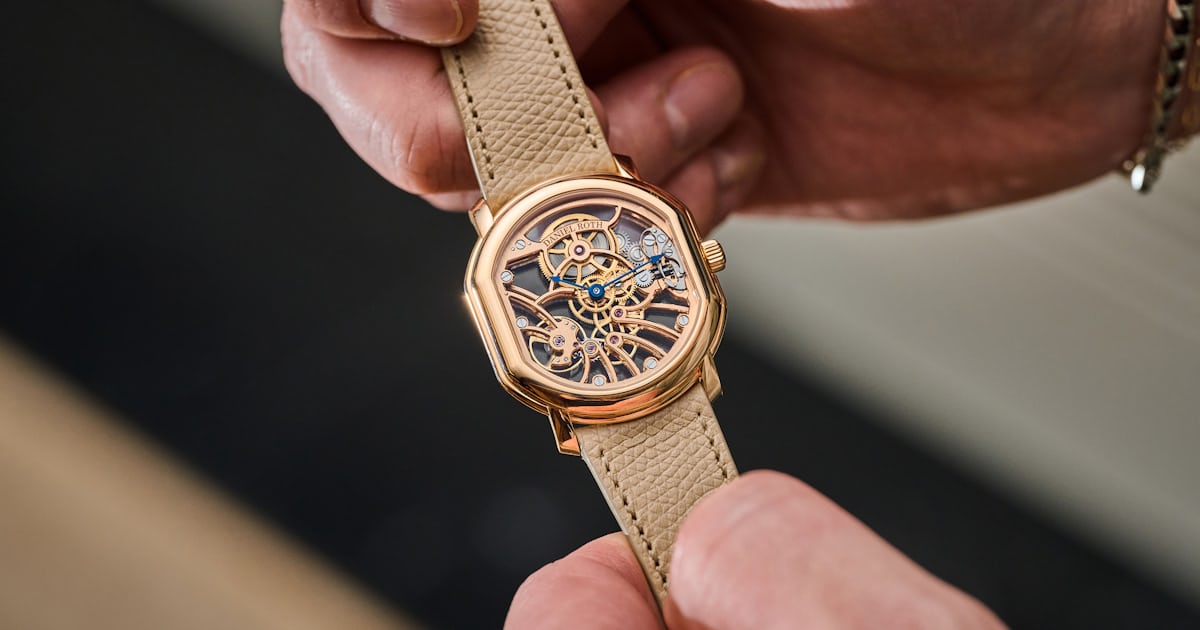
The Daniel Roth Extra Plat Squelette (or Skeleton, for us English-speakers) is a small change for the brand, yet still something the brand hasn’t done before. Technically, most of what the team is doing now is somewhat uncharted territory for the brand—Mr. Roth wasn’t making his own calibers, after all, but instead modified and finished based on ébauches from Nouvelle Lemania, Frederic Piguet, and others. But this is the first all-new Daniel Roth from the relaunched brand: it’s comfortably familiar but (unlike the previous tourbillon or Extra Plat) a model the original brand never did. And damn, does it look great in the metal.

First of all, look at that caliber. While I’ll show another comparison later, the DR002SR movement isn’t just the previous Extra Flat cut into, but rather reimagined. The bridges and base plate are made in 18k rose gold, which blends seamlessly into the case. Instead of matching the gears, keyless works, and winding mechanism, the brand left it all (as well as the screws) purposefully as-is to create a three-tone movement for contrast.

Legibility (which I will repeat multiple times in this story, my apologies) is an obvious concern, but we don’t read watches on the wrist in a two-dimensional reality. If you lift your arm to look at your wrist, tilting and turning, light shifts, and you can relatively easily tell the blued hands from the bridgework and pick out the time. You also get the added benefit of a built-in power reserve indicator, of sorts, because you can see the state of the barrel winding. On that note, the watch runs at 4Hz with a 65-hour power reserve.

You can’t see the differences comparing the dial side of the watches, but using this image (below) of a prototype of the most recent Extra Flat Souscription, you can see that the team has reimagined some of the shape of the bridgework. The balance cock keeps the same sweeping form, but the location of the screw holding it (among others) has been slightly relocated. You get three skeletonized finger bridges (actually all one connected piece) that roughly follow the larger lower bridge plate shape, but the central pinion and larger upper bridge have been designed to imply a bit of symmetry (even when there is none)


The finishing itself really stands out. In addition to that nice choice of tone-on-tone finishing, the decoration is very cleanly done. I didn’t count the interior angles (frankly, I refuse to do that as I would like to have a personal life), but the brand said it’s around 80. The anglage itself catches highlights and shadows in a way that adds a lot of depth. The reverse side of the bridges is vertically brushed, and the gears themselves have anglage as well.
For the uninitiated, that’s the hallmark of handwork, though not all interior angles are the same. The bridge cuts began with electro-discharge machining, then were further refined and polished. If you look at the sets of screws, for instance, you can imagine how tight the space is and how hard it is to get tools into it. Then, add in the fact that some of these spaces require two internal angles in that space, curving around the screw, and you can imagine the difficulty. Another good example is the arm that supports the third wheel, which curves around the mirror-polished intermediate wheel for the keyless works. It’s a tight, yet beautifully done curve.


Add to that the fact that the watch wears incredibly well. The wonderful duo of James Stacey and Tim Jeffreys were in the meeting with me, and I believe it was James who really emphasized how great the wearing experience was. The lug profile and where they sit on the case have been reimagined from the vintage Extra Plat versions, which had straighter, flatter lugs. Now, the slight downturn and rounded shape help the watch hug the wrist for a variety of wearers. The 38.6mm x 35.5mm measurement wears (to me) more like the 38.6mm number, yet just a touch more elegant.


And yet, it wears even better than the standard Extra Plat thanks to two important metrics. First, the watch is nearly a full millimeter thinner (now 6.9mm), which emphasizes the true extra-thin experience. It’s subtle in pictures (you can see the skeleton above and the regular one below), but pretty noticeable on the wrist. But it’s noticeably lighter, too. It’s not just because so much material has been removed from the movement, but the use of a solid-gold dial on the original version adds a lot of weight.

In the standard “less is more” version of watchmaking (less material, more cost), the Extra Plat Skeleton retails for CHF 85,000, compared to the non-skeletonized Extra Plat for CHF 49,000. It’s a huge increase, but it’s not about the material, but rather the work involved—you can really see the value of the handwork in person. And on that topic, because of the extra work, the watch is in limited production.
Comparison Shopping
Comparing skeletonized watches is harder than you’d think. If you Googled “best skeletonized watches” and ended up on some SEO-optimized website with a list of 25 watches, you’d quickly realize that, amidst the AI-assisted story scraping up remnants of dead internet traffic, there’s a sad fact: most skeletonized watches on the market either aren’t actually skeletonized or are just kind of bad. I also don’t care to open up the can of worms of comparing one skeletonized dress watch to something wildly unrelated, like a Zeitwerk. They’re two different things.
True skeletonization is labor-intensive and only successful if done that way. You need a caliber designed for, or capable of, removing a ton of material. Cutting away a bit of the dial and saying “hey, you can see through the gears” is a half-measure and should be tossed out as disingenuous. Even if you use electro-erosion, there should be a lot of handwork and minimal structure to the movement. The skeletonization of a movement should be the point, not an add-on. So, while this list isn’t exhaustive (and it skips sportier models or obvious choices like a neo-vintage Breguet 3355 Tourbillon that is way outside the comparative budget), it’s also kind of a lot of what’s left that fairly fits the bill.
The Cartier Privé Skeleton Options — Crash, Cloche, and Normale (et al.)

If you’re looking for a brand that understands dress watches, Cartier is the obvious choice. If you’re looking for one that knows how to skeletonize a watch creatively, you’re still in the right place. While Cartier’s skeletonized variations of iconic designs (I’m thinking of the Crash, Asymétrique, and Normale, but there were Cintrées, Tank Louis—I could go on) don’t emphasize hand finishing or interior angles that Daniel Roth did, they know how to remove as much of the movement and dial as possible to create the required effect. And then they keep on doing it over and over, which is good for collectors.
To my knowledge, there are no publicly available skeletonized watches from Cartier currently, except for a variety of Santos-Dumont pieces, which don’t fit my personal remit for comparison. But the brand recently did some “Temple Exclusive” skeleton watches available in NYC, London, and Paris, so you can assume there will be more coming eventually. When the Asymétrique was introduced in 2020, prices ranged from $61,000 to $70,000, depending on the material. The Normale, in platinum, was around $80,000. The Skeleton Crash (which is a bit less classic) was around the same price but goes for hundreds of thousands on the secondary market. You could wait for the next one, sure, but I nearly guarantee you won’t get one at retail unless you’ve bought basically everything else from Cartier in the last few years and already have a stack of Privé models.
Blancpain Villeret Squelette 8 Jours ref. 6633 1500 55B

Next up on the list is a relatively compact Blancpain with some impressive technical benefits over the Roth: namely, it can run a long time. Eight days in fact. A longer power reserve means more barrels (three here in series), which means more of the movement is filled with coiled springs that don’t let light through to show off the skeletonization work (which feels like it should be the point).
The visual is still pretty solid, albeit a bit dated (to my taste), with the engraving on the bridges reminiscent of 1980s and 1990s skeleton work. As impressive as the engraving is, it just makes the skeletonization look a bit less clean. The interior angles might be nice (they might not be), it’s hard to tell without the watch in hand. I think with finely finished plain bridges, this could be stunning. But viewed from the right angles, even putting my biases aside, it’s a technically and somewhat aesthetically impressive watch (especially since you can pick them up for $25,000 on the secondary market—about $70,000 off retail).
Audemars Piguet Classique ref. 5442BA, ref. 14232BA, etc.
Audemars Piguet was the first brand that came to mind for this comparison. Between the world-class Royal Oak and Code 11.59 Flying Tourbillon versions, the brand has shown that it gets the brief of how to skeletonize and when to call it openworking (like the Double Balancier). But those are wildly expensive, so let’s go back in time.

A vintage AP “Classique.” Photos courtesy Watch Brothers London.
Hypocrisy incoming here, but the same engraving that I found dated on the previous watch, I actually like on the AP “Classique” ref. 5442 and similar models. I think that’s fair, as one looks a bit stuck in the past, while the other literally is from the past. Then there’s the fact that I have a soft spot for this watch because I’ve been trying to buy one from a friend who said, and I quote, “I never wear it,” and added he doesn’t like that much, but “never said I wanted to sell,” even if I flew halfway around the world to see him. Spending time with a friend should be enough, but sometimes you want the watch to go with it. But I digress.

These are small watches at 33mm, and the legibility isn’t that great compared to the Roth. It’s also obvious that the caliber, while very finely skeletonized (to the point that it almost looks worryingly fragile at some bends), wasn’t designed for the visual impact of the Roth. For the ref. 5442, it’s actually the same base caliber used in the ref. 5402. The winding rotor makes it a bit less impactful as well. And yet, there’s the nostalgia. I like it, it scratches an itch that a modern Patek offers at $140,000, and yet, at $10,000-$20,000, it doesn’t hurt the wallet too much.
Final Thoughts
I think it’s pretty clear that I was captivated by the Extra Plat Skeleton when I finally saw it in person, but I’ve found that I have to remember the experience wasn’t captured by a wrist shot like the one shown below. Yes, on a two-dimensional plane, it suddenly looks less legible and a lot more impractical than I ever felt in the hour or so I had the watch in front of me or on my wrist, but that’s the failing of the medium we work in and the key to seeing things in person. That aside, it also remains a somewhat niche offering made in limited numbers. A normal Extra Plat would serve most people better, save a bit of money (down from the CHF 85,000 price tag here), and give you a great wearing experience. But as a representation of a new era for Daniel Roth, I don’t think you could ask for much more.

For more on the Daniel Roth Extra Plat Squelette in rose gold, visit the brand’s website.
Source: www.hodinkee.com — original article published 2026-03-12 15:00:00.
Read the full story on www.hodinkee.com → [source_url]