Editor’s pick — Accessory quick take: key highlight (movement/specs for watches, materials/finish, limited run, pricing tier) in 1–2 lines.

Happy Friday the 13th, Ballers. It is time to exhale. Close your meditation app and find some peace in some watches that, whatever else they’ll offer, will allow for a little daydreaming for ten minutes on a Friday.
First things first: whoever snagged the Patek 2508, congrats. Had I been a bit more on the ball, I would have included it, but last week was the first of what will likely be a few instances of catching a watch, writing it up, and then an early Friday check revealing the thing had already sold. Last week, it was this lovely Longines 13ZN (which had a non-matching case and movement, but was still quite fun) that went for €7,000. Congrats to whoever ended up with it; that surprise sale led me to insert the Glycine.
As far as watches not quite meriting a full write-up this week, here’s a late-70s Heuer 1589B, featuring the Valjoux 7765, and if that’s not quite your speed, here’s the Heuer’s off-brand cousin. I appreciate that the 7765 layout—thirty-minute counter at 12 o’clock, running seconds at 9 o’clock—is not everyone’s cup of tea, but there’s a sort of rough punk charm to these two.

Scorekeeping last week’s picks: Arrow of Time’s AP ZVSC sold within 24 hours, restoring one commenter’s faith in humanity. The Girard Perregeaux 9034 Playboy/Moon is still available until around 2:00 pm EDT on Friday, the Sportway skin diver for $396, and you’ve also got a bit more time on the Glycine Airman (it’s $543 at the time of writing). On to this week’s watches. Thanks as ever for reading.
A Quartz Vacheron Constantin 222 ref 46003

Photo courtesy Piguet Hôtel des Ventes.
This watch has had me in fits for nearly a week now.
You know the background on Vacheron Constantin’s 222. Released in ’77 to celebrate the maison’s 222nd anniversary, it was the only integrated-bracelet sport watch model from the ‘holy trinity’ not designed by Genta—Jorg Hysek designed the 222. Over the lifespan of the model, 3100 examples were made in various metals and sizes (the 37mm jumbo, the 34mm mid-size, and the 26mm ladies), and the 222 spent years in the shadows of the Royal Oak and the Nautilus. This oversight made the model (relatively) less expensive, but those days changed, culminating in 2022, when Vacheron Constantin released its Les Historiques 222 in gold, and then, last year, in steel. They’re beautiful watches, but given that I’m as likely to buy a Vacheron Constantin 222 (vintage or reissue) as I am to purchase tickets to space, I’ve been able to enjoy the model with the detached purity of someone who will never have skin in the game.

Photo courtesy Piguet Hôtel des Ventes.
What I had not known (until coming upon this watch) was that the mid-size 34mm model, reference 46003, had also been available with a quartz movement.
That, sadly, is about the full extent of background I can offer because, despite digging for info and asking several folks far more knowledgeable than I, nobody could offer much about a mid-size 222 with a quartz movement. That’s not all that surprising, as there were only 1000 mid-size models made, the vast majority of which would’ve been automatic. I will note that the mid-size 333, released in 1984, was offered with a quartz movement, so perhaps this watch (manufactured in 1982) was something of a test run.

Photo courtesy Piguet Hôtel des Ventes.

Photo courtesy Piguet Hôtel des Ventes.

Photo courtesy Piguet Hôtel des Ventes.
This particular example is therefore as interesting for its oddness as anything else—it’s not often in 2026 that any of us can find a 40+ year-old watch that really seems to have little traceable history. The watch itself looks beautiful, though the notes clarify that the case has been repolished. The watch comes with an archive extract, which at least should offer some comfort regarding lingering questions about authenticity, and, given my inability to find comps, I couldn’t begin to guess whether the CHF 5,000 to 7,000 estimate will be accurate. Could this be a (relatively) affordable entry point to a model I’d presumed impossibly out of reach? The auction is set for the 19th, so stay tuned to find out.
Corum Golden Bridge 05.0002
I have a weakness for this type of JLC clock—I’ve seen it referred to as skeletonized and inline, so I’m unsure what to call it. While there’s nothing inherently special about a clock’s components arranged vertically, there’s something almost soothing about its austere simplicity. I asked a few watchmakers if they knew of other clocks thus arranged, and all admitted there must have been someone who did it before Jaeger-LeCoultre, but they didn’t know of any off the top of their heads.

Photo courtesy Das Kunst und Auktionshaus Kastern GmbH & Co.KG.
My fondness for that clock led to a fair jolt of enthusiasm when I came upon this Corum Golden Bridge, but, strangely, there’s no relationship between the two whatsoever. My understanding of and appreciation for Corum has, until now, been strictly limited to the Admiral line, particularly 1980s and 90s models with flag dials, each of which looks like what one of my friend’s dads would’ve worn in the mid-90s while we rolled our eyes and headed out to sneak cigarettes and talk about Pearl Jam or something.
What I hadn’t known, though, was that in 1977, the same year Vacheron Constantin released the 222, Vincent Calabrese was presenting (and winning a gold medal for) what he called his ‘linear movement’ at the Geneva International Inventors’ Show. The patent for the movement was then acquired by René Bannwart of Corum, and the Golden Bridge model was launched in 1980.

Photo courtesy Das Kunst und Auktionshaus Kastern GmbH & Co.KG.
Despite the watch’s restrained formality, there’s a defiance to it, or at least in its origin story. According to Mr. Calabrese, he was servicing a watch when the customer said something sniffily dismissive about the relative unimportance of a watch movement, given it wasn’t visible, and so he decided to, in his own words, “produce a timepiece where the movement, and not the case or design that is the star.“
This specific model is from the aughts and features an 18k gold rectangular case that’s 32mm wide and 50mm lug-to-lug. The caliber 7000 is manually wound with the crown at 6 o’clock, and while the listing provides only a measly three pictures, with a little digging, you can find plenty of shots showing the full wildness of the sapphire crystals on the front, back, and sides, each revealing some new view of that beautiful movement.
The starting bid is €6,000, and the auction’s in a week, meaning I’ve got time still to convince myself that maybe I’m entering my Dress Watch Era.
An 18k Ebel 1911 Reference 8134901
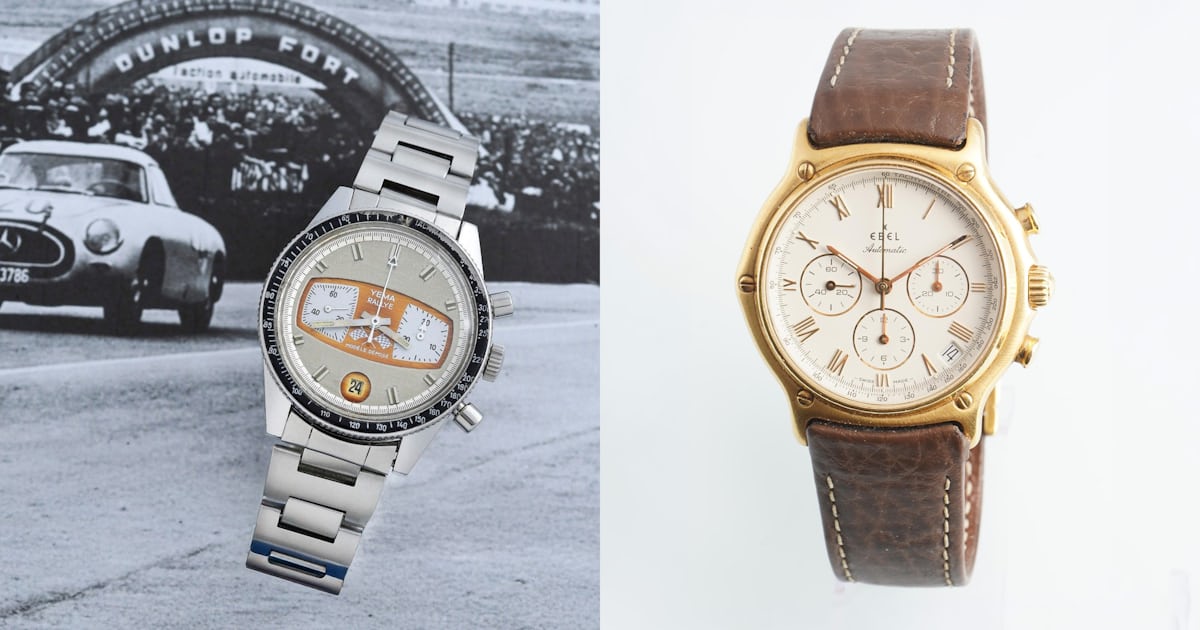
This is a solid-gold Ebel chronograph powered by a Zenith El Primero movement. It’s the same model Don Johnson wore as Sonny Crockett on Miami Vice, and it comes with paperwork showing it was serviced in 1996. Is there anything else you need as an incentive?

Photo courtesy Antikauktion Krefeld.
I do not know if I authentically like Ebel watches with their rounded edges and blobby cases, mushroom pushers, and the screws on the bezel, or if I’ve been sort of culturally and horologically ground down and/or brainwashed over time. It probably doesn’t matter either way (I didn’t like Weezer the first time I heard them), and I now find myself, if not instinctively drawn to 1980s Ebels. I’m at least no longer as quick to dismiss them.

Photo courtesy Antikauktion Krefeld.
This watch—with an opening bid of €2,200—seems in good shape, with its seemingly flawless dial being the biggest draw. There is, too, what’s likely a Zenith El Primero cal. 400 beating within (Ebel badged it the 134), and given that movement’s pedigree, that might be reason enough to take a swing. The auction will be held tomorrow, on the 14th, so plan accordingly.
Choose Your Own (Yema) Adventure
For a stretch in the 2010s, it felt like there’d been some declaration by a shady organization that we were living in a Time Of Rediscovering Vintage Chronographs (I suspect it’s felt that way at plenty of other times, but that’s when I experienced it). The Daytona had been famously underloved for years. Scholarship about the Speedmaster had been so scant for years that there was actually a time when nobody cared about a dot’s proximity to 90s. People didn’t even know if the Skipperera was an actual watch that Heuer had ever released, and Nina Rindts had once sold for under $3000. As all those watches blew up, there seemed to be this rush to find the next overlooked watch, the next under-appreciated brand.

Photo courtesy Hôtel des Ventes Bordeaux Quinconces.
This one’s powered by a Valjoux 7734, and the same movement presumably beats in this one, though that’s not articulated in the listing. Both watches look in the sort of good, used shape you’d expect of a 55+ year-old sport watch, though the former’s bezel is a fair bit more tatty than the latter’s. I’m sure someone knows far more than I do and could detail the exact models on offer—for a while, I know there was a Formica Rallye and a Brown Sugar one as well, though I never got conversant at that level of specificity and complexity. To these under-educated eyes, they both just look like great late-60s/early-70s sports chronographs, it’d probably be tons of fun to wear.

Photo courtesy ADJUG’ART.
There’s also this Yachtingraf, another model Yema’s rereleased, though unlike its modern brethren, this example features the glorious countdown timer at the 3 o’clock register. I’m a little stunned at the condition of this watch—it comes with its certificate of origin, noting a sale in 1978, meaning this thing’s 48 years old and, save for some scratches on the crystal, isn’t showing its age much. We should all be so lucky.
The first Rallye’s got a €3,000 to €4,000 estimate and sells on the 22nd, while the second Rallye’s estimate is only €1,200 to €1,800, the Yachtingraf’s €2,500 to € 3,500, and both of those sell on the 17th.
Buyer Beware: A Very Incorrect ‘Tudor Ranger’
The Tudor Ranger is a deserved legend. It’s one of those watches that somehow manages to be just right, the Goldilocks ideal. I’ve yet to try on one of the new 36mm ones (the originals were 34mm), but I imagine they come real close to scratching the itch.

This watch is not a Ranger by any stretch of the imagination. The biggest flag is the red Ranger badge: there is no red Tudor Ranger. Past the dial, this watch offers plenty of trouble: the hour hand’s way too short and the wrong shape, and the seconds hand is wrong, too. Reader, stay firm with yourselves! Do not let ancillary swag (in this case, a modern Tudor pouch) in a listing lead you astray! Fingers crossed, at some pointthere’ll be a legitimate example we can list and discuss here.
Source: www.hodinkee.com — original article published 2026-03-13 15:00:00.
Read the full story on www.hodinkee.com → [source_url]