Editor’s pick — Accessory quick take: key highlight (movement/specs for watches, materials/finish, limited run, pricing tier) in 1–2 lines.

We’ll have further auction coverage in the coming weeks, but it’s worth giving Phillips a bit more attention, as it continues to lead in year-over-year sales. The auction house sold a record total of over $290 million in watches last year and has had five years in a row with over $200 million in sales. The market has shifted (I’d argue at least twice) in the past few years, but despite the growing F.P. Journe, independent, and pocket watch (yes, pocket watch) markets, the top lots for Phillips continue to be Patek Philippe.

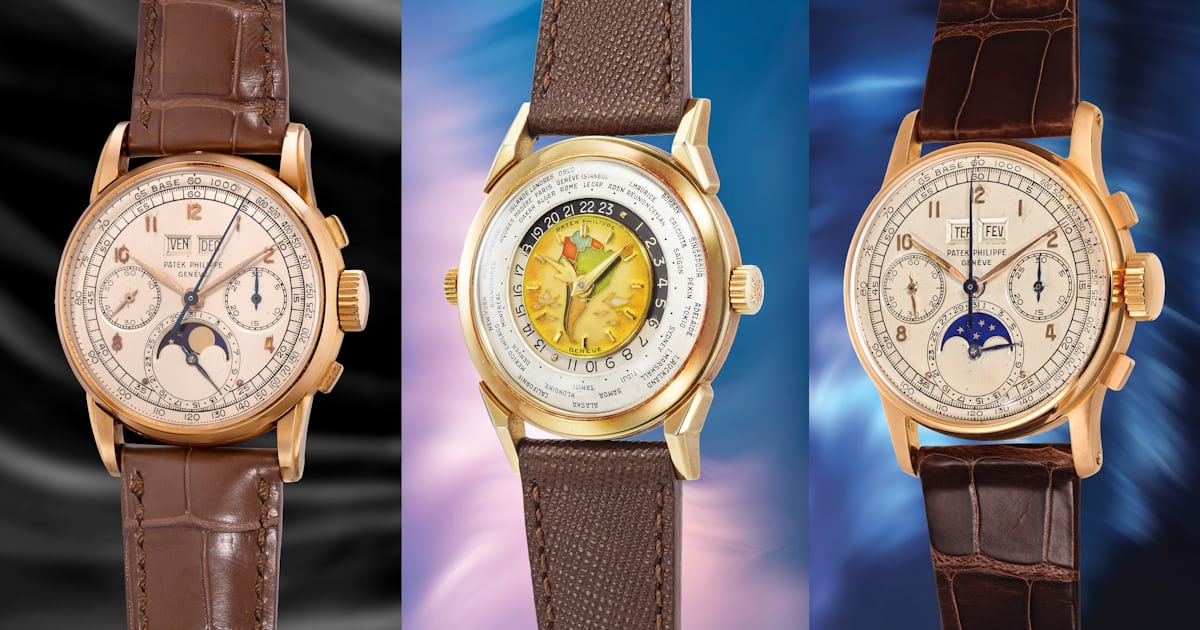
At each of their spring auctions, Phillips is selling an important Patek to headline the sale, and each is the kind of watch that could be the pinnacle of the world’s top collections. Normal caveat here: I haven’t seen these watches in person yet, and anyone considering bidding should make sure to check any watch in person if at all possible.
A Patek Philippe ref. 2523 Two-Crown World Time With Cloissoné Enamel South America Dial
First, we have the star of Geneva, to be sold on May 9: the Patek Philippe ref. 2523 two-crown world time with cloisonné enamel map of South America, from 1953. Aside from rare variants of 2499s or 1518s (and a few repeaters), these two-crown watches, with their incredible, angular lugs and giant open canvas at the center of the dial, have become the holiest of Holy Grails for many collectors. They are rare enough to be hunted and coveted, but there are also enough out there to be studied, understood, and codified. Too rare or esoteric, and things are hard for anyone but scholars to understand (and those scholars rarely have the cash to break records). Too common and it’s not interesting, and you can always wait for the next one. Add in the beauty of the watches, and you have the perfect storm for high-end collectibles. That could be said of all three watches here.

Photo courtesy Phillips.
Phillips has a great breakdown of all known 2523 across the two series, but this is the only version with a South American map to appear at auction, and the last time it was seen was 38 years ago. That’s basically a lifetime for a rare watch to sit behind closed doors, especially in this market. There are an estimated 25 to 36 examples of the ref. 2523 ever made, and, complicating things even more, the Patek Philippe museum owns four of them. It’s not so much that they were hard to make at the time; it’s just that, for whatever reason, people didn’t really like them back then, which adds to the rarity.


While Eurasia and North America maps can feel a bit crowded, and guilloché dials are good but plain, here we have a smaller but beautiful polychrome enamel outline of South America and all the countries, with extra flourishes like a ship, fish, and waves on the outskirts. While the other example is known and photographed (in an out-of-print book from 1997), there is a rumor among collectors of a third, pink-gold 2523 with a South American map (a rumor I’ve heard for years). Imagine what that might go for if it were real. A pink-gold version with solid blue enamel and the Gobbi Milano signature set a record for the most expensive watch sold in Asia for just shy of $9 million in 2019 (before the market boom), so I imagine this version could very well eclipse that price against an estimate in excess of CHF 5,000,000.
Phillips has (rightfully so) added many photos of the dial out of the case, the movement, the case, and the hallmarks, which are essential for evaluating a watch like this. The best picture is of the rear of the enamel, which bears the movement number etched into the metal, ensuring it’s the right dial for the right watch. To repeat myself, if you’re going to spend that much money, you should definitely be looking at it in person or paying someone you trust to do it. The dial looks to be in great shape, with a lot of patina and no obvious cracks, unlike those you see near the indices on some cloisonné dials (which are common). The case retains the dynamic shape you want on a 2523 and looks stronger than the 2523 Eurasia dial that we covered previously.
A First Series Pink Gold Patek Philippe ref. 2499 at Phillips Hong Kong

Photo courtesy Phillips.
Next, in Hong Kong, is the first time a first-series pink gold ref. 2499 with a Vichet case is ever coming to an auction in the region. Out of all the 349 ref. 2499 made, fewer than 50 were the “first series” versions with their distinct case and rectangular pushers more reminiscent of the ref. 1518 that preceded it. Of those, only four were in pink gold with a Vichet case, which has longer, claw-like lugs, a smaller diameter, and a flat caseback compared to later Wenger cases. This example—which was last sold in 2014 at Christie’s 175th Anniversary Patek sale—has British hallmarks stamped into the case, a tachymeter in kilometers, and the early outside railroad track.

Photo courtesy Phillips.

Photo courtesy Phillips.

Photo courtesy Phillips.
And, man, is a first-series 2499 a thing of beauty, especially with the Vichet case. Sure, it’s a bit smaller in diameter, but those lugs are tremendous and so complex. The case feels a bit less rosy than the following watch (another rose-gold QP chronograph), but the hallmarks look solid. The dial looks nice too, and pretty sharp. If there was any cleaning of the zappon layer, it must have been done very lightly and a while ago, since the dial still has that fine texture and no obvious brushing, nor does there seem to be major missing raised hard enamel text. The estimate is $3,000,000 to $6,000,000, compared with the previous result of around $3.3 million. Phillips estimates are always (sometimes comically) conservative, and they like to estimate in the range of the hammer price, not all-in, but as you get into the big ticket items, they start to seem more on the money. I’d expect that you could see toward the high end or a bit above, but you can never tell the whims of people with so many zeroes in their bank account.
A Vichet-Cased Pink Gold Patek Philippe ref. 1518 at Phillips New York
Last but not least (although, I guess only least in the estimate range), is the fresh-to-auction-market ref. 1518 in pink gold to be sold in New York. Out of 281 of the reference 1518 (the world’s first serially-produced perpetual calendar chronograph), only 58 were made in pink gold. Fifteen of those are the coveted “pink-on-pink” with salmon dial, but if you had to choose between a “rough” pink-on-pink (the one from Phillips Decade One sale last year was not my favorite, for example) which still would fetch over $4.5 millon on a bad day versus contending for a museum-quality piece like this one with a “plain” silver dial, I’d take the latter every day of the week.

A fresh-to-auction-market Patek Philippe ref. 1518. Photo courtesy Phillips.
Like the 2499, the case here was made by Vichet, and it’s a great one. According to people who have seen the watch in person, you’ve got super clean hallmarks on the case, which is unsurprising, seeing as the edges on the case, especially the lugs, are super strong despite some tiny dings and dents and decades of wear that would have once been tempting to buff out. The dial might look rough, but it appears completely untouched (in pictures). What you’re looking for here are the strengths of not just things like the accent over the “E” in “GENÈVE,” but bigger things like the incuts around the windows for the date and the subdials. They all look sharp and clean, and, more so, have bits of grey and green in the corners and edges, as well as the same where there are scratches and small pocks on the dial.

Patek Philippe ref. 1518 in steel, movement 508’474 (number 2 of four known). Photo courtesy of the collector.
This is reminiscent of the “Number 2” 1518 in steel, where the silvered dial looks terrible at a glance, but really what you are seeing is how cracks in the protective zappon have (for better or worse) allowed oxygen to oxidize the silver underneath. You can tell from that the dial has been untouched (or at least not touched for a while) and not abraded or “cleaned” down. You can see the comparisons. If you want to know what an untouched 1518 looks like, this watch at Phillips New York is a pretty solid example and feels worthy of the $1,200,000 to $2,400,000 estimate.
I’ll be curious to see how the market reacts to these watches. These are very much for the old-school kind of collectors who prefer slightly more scholarly watches with historical cachet. The market shift is trending toward the indies and F.P. Journe in particular, which, in many ways, makes sense. These are the watchmakers who are alive, hard to get, and you feel like you can connect with and support. They’re also obvious flexes to the wider world, in the way a Paul Newman Daytona is. Your rich friends are probably more aware of F.P. Journe now than of a 1518. But if you’re building your own personal, historic museum of mid-20th-century watchmaking blue-chip pieces, these three Pateks are still where it’s at.
For more on the Phillips Watch Auctions, visit their website.
Source: www.hodinkee.com — original article published 2026-04-23 17:00:00.
Read the full story on www.hodinkee.com → [source_url]