
Editor’s pick — Accessory quick take: key highlight (movement/specs for watches, materials/finish, limited run, pricing tier) in 1–2 lines.

What We Know
No brand leans into stone dials quite like Piaget. For 2026, the Maison expands its use of ornamental stones across a wide-ranging lineup, led by a new Polo 79 with a deep blue sodalite dial. Piaget’s relationship with hardstone goes back to the early 1960s, when it began experimenting with materials like lapis lazuli, turquoise, malachite, and tiger’s eye, turning the dial into the focal point of the watch. At the time, stone dials were one of the only ways to achieve saturated, uniform color on a watch, giving Piaget a distinctly different visual language from its peers. By the 1970s, that approach had become a defining part of the brand’s identity, aided by the ultra-thin 9P movement, which allowed for wider, design-forward dials.

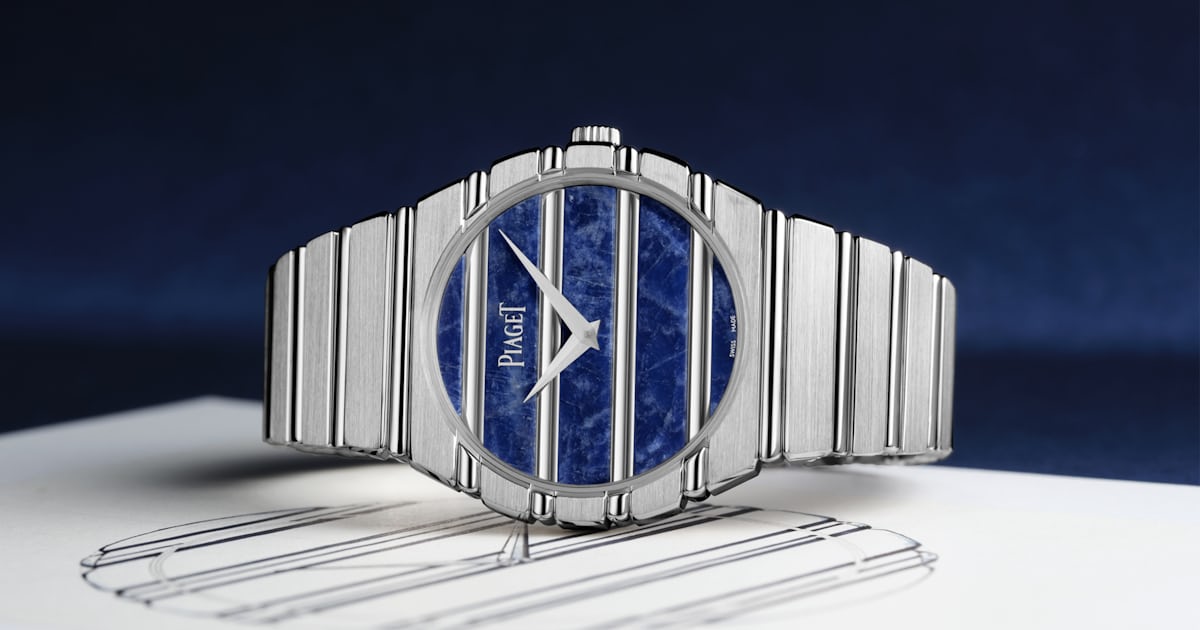
At the center of this year’s releases is the Polo 79, now rendered in white gold with a sodalite dial. The watch retains the familiar architecture of the yellow gold and two-tone models: a 38mm case with gadrooned finishing and an integrated bracelet, but the addition of stone shifts the emphasis. The dial, with its natural veining, introduces variation from piece to piece, reinforcing Piaget’s long-standing focus on material as the primary design element. It’s the kind of detail that made stone dials so appealing in the first place, as they are slightly irregular, and therefore impossible to replicate exactly. The watch is powered by Piaget’s in-house caliber 1200P1, an ultra-thin automatic micro-rotor movement measuring just 2.35mm thick, with a 44-hour power reserve.

Beyond the Polo, Piaget pushes this idea into more expressive territory. The Swinging Pebbles necklaces reinterpret early 1970s forms, carving the case and dial directly into ornamental stones. Executed in verdite, pietersite, and tiger’s eye, each pendant is suspended from a twisted gold chain.
At the more elaborate end, high jewellery cuff watches take a different approach. A rose gold cuff set with diamonds frames a turquoise dial, while the Sixtie high jewellery version pairs an opal dial with an articulated bracelet and Décor Palace finishing. In both cases, the watch is secondary to the overall composition. Piaget also brings the idea into a more restrained format with the Sixtie, a compact trapezoidal watch with a blue quartz stone dial, translating the same material focus into something smaller and more wearable… and more affordable.


There’s also a technical extension of the idea. The Altiplano Ultimate Concept Tourbillon integrates a tiger’s eye dial into its 2mm-thick case, folding ornamental stone into one of Piaget’s most technically ambitious platforms.
What We Think
Piaget doing stone dials certainly isn’t new. But the scale of this release matters. This isn’t a single nostalgic nod; it’s a coordinated return to one of the brand’s most defining ideas: that the dial is the point.
What’s interesting is that this is happening now. Technically, there’s no longer any need for stone. Brands can achieve almost any color they want through lacquer, ceramic, or synthetic materials. And yet, there’s still something more compelling about color that occurs naturally. The irregularity, the inclusions, the fact that no two dials are ever quite the same. It introduces a level of unpredictability that modern watchmaking usually tries to eliminate.

That tension is part of the appeal. Stone dials sit somewhere between control and accident, design and geology. They feel slightly irrational in a category that often prioritizes precision above all else.
The Polo 79 works because it grounds that idea in something familiar. It’s a known shape, a known watch, now reinterpreted through material. The necklaces and cuff pieces push further, closer to where Piaget has historically been most interesting: when the watch stops behaving like a watch and starts behaving like jewelry.
The Basics
Brand: Piaget
Model: Polo 79
Reference Number: G0A51151
Diameter: 38 mm
Thickness: 7.45 mm
Case Material: 18k white gold (satin finish with polished gadroons)
Dial Color: sodalite stone dial
Indexes: None
Lume: None
Water Resistance: 50 meters (5 ATM)
Strap/Bracelet: Integrated white gold bracelet with folding clasp
The Movement
Caliber: Piaget 1200P1
Functions: Hours, minutes
Power Reserve: ~44 hours
Winding: Automatic (micro-rotor)
Pricing & Availability
Price: CHF 84,500
For more, click here.
Source: www.hodinkee.com — original article published 2026-04-18 13:00:19.
Read the full story on www.hodinkee.com → [source_url]