Editor’s pick — Accessory quick take: key highlight (movement/specs for watches, materials/finish, limited run, pricing tier) in 1–2 lines.

It’s time for the Geneva spring auctions, the premier venue for the biggest lots and market-moving of the year. That’s not to say that Hong Kong (which sometimes comes before, sometimes comes after) or New York (which rounds out the season) won’t have some big lots. Sotheby’s Hong Kong sale—which we covered previously—closed over the weekend with an absolutely shockingly great result, with massive prices across the board, especially for Cartier. The final total? $52,875,885, which is more than $10 million more than their previous record and the highest total for a watch sale in Asia..
There were a number of records and massive results, which included nearly $2 million for a Cartier London Crash (a record), a London Tank Asymétrique went for a surprising $750,000, a skeletonized Baignoire was just shy of a million at $950,000—and that doesn’t count things like the $1.96 million for a unique single-button Patek chronograph or $1.5 million for a “John Player Special” Daytona. A white gold A. Lange & Söhne Tourbillon Pour le Mérite sold for $1.3 million, which is wild, considering a few of these sat on the market for nearly a year for a third of that price as recently as two years ago. Truly remarkable and, frankly, confusing results up and down the board. Which begs the question: do we think crazy prices for Cartier will hold long term, or was it just excitement for the first round of sales? I’d bet the latter, with a lot of question marks about how they got there in the first place.
Checking in on other results, the Monaco Legend Auction sold 98.3% of its lots for a total sale of €26,471,620. Big results include €2.106 million for a unique doré-dialed Patek 3448 “Padellone,” €1.88 million for a unique platinum Daytona, and, what I was impressed by, the €390,000 for a Cartier Tank à Guichets that was made in 3 examples, among other solid results. A unique woven Cartier ”Pebble” did massively well at €136,500, but otherwise, I wouldn’t say the Cartier results were as insane as at Sotheby’s. We’ve also already given some shine to Phillips’ recent success and the big lots they’ve got coming. But it’s a big auction season, so we’re splitting the preview into two parts, with Christie’s and Sotheby’s coming next week.
But unless you’ve got about ten to fifteen million dollars burning a hole in your pocket for the top lots at Phillips, it’s worth browsing through all the catalogs yourself. But we’ll try to tackle digging through them a bit as well. Well, some auctions we’ll go further down the catalog than others. There are just too many important watches not to shout out. If you notice that we’ve skipped some pocket watches, that’s intentional. I hope to write about them in the future, but they’re worth looking at on your own (because they’re truly amazing). So without further ado, let’s dive into the first part of our massive preview.
Phillips – 225 Lots – May 9 and 10

Rare Handcrafts Patek Philippe ref. 6002G-010 Sky Moon Tourbillon. Photo courtesy of Phillips.
Alright, so we previously mentioned Phillips’ important Patek Polychrome enamel world time ref. 2523, but the other extremely big-ticket lot for Phillips this spring is the Rare Handcrafts Patek Philippe ref. 6002G-010 Sky Moon Tourbillon. It reminds me more of hand-engraved silver from the American Southwest than of a traditional Swiss watch, and it also has a front dial (it is a double-dialed watch, after all) with cloisonné and champlevé enamel. As far as I remember, the only other time this variation has come up for sale was in 2019, when one sold for $2.4 million. The estimate is now CHF 2,000,000 to 4,000,000.

Rolex ref. 6085 with “Dragon” enamel dial made by Nelly Richard. Photo courtesy Phillips.

A Jean-Claude Killy ref. 6036. Photo courtesy Phillips.

A Champagne “Paul Newman” Daytona. Photo courtesy Phillips.

A Rolex ref. 6062 Triple Calendar.
Of course, there are some interesting esoterics from Rolex. It feels like the Rolex market has softened a bit, or at least slowed down. Paul Newman Daytonas don’t get people worked up into as much of a lather anymore (thank god), but there are a few cool Rolexes. The very clean ref. 6062 Triple Calendar in steel will get a lot of interest (CHF 500,000 to 1,000,000), but I love this yellow-gold Jean-Claude Killy ref. 6036 (CHF 500,000 to 1,000,000) is more my speed. As is this amazing ref. 6085 with “Dragon” enamel dial made by Nelly Richard.
Another one of these dials, in a ref. 6100, sold last fall at Sotheby’s for $1.75 million. The estimate here is CHF 500,000 to 1,000,000. Without seeing them in person, it’s hard to compare how each stacks up, though it is my understanding that the ref. 6100 is rarer. Finally, it makes me happy that all these have higher estimates than the previous king of auctions, the Champagne “Paul Newman” Daytona (CHF 350,000 to 700,000). For something to troll your friends with, you can buy a steel Day-Date (yes, they do actually exist).

I know I promised to ignore pocket watches, but if I’m going to break my own rule for one watch, it has to be for this Agassiz. Arguably the most historically important lot of the year (maybe for the past few years), this watch was gifted as the “Victory Watch” to General Charles de Gaulle for the Allies’ win during World War II.
Four pieces were given to the Allied leaders on Christmas 1945. The project was undertaken in secret, with Louis Cottier himself a part of the effort, and the famed Stern Frères (yes, the family that owns Patek, for those who don’t know) was tasked with the dials. The watch here features Joan of Arc with an hour hand in the shape of the Cross of Lorraine (the symbol of Free France during the resistance). The caseback has a “V” for “Victory” encircling the globe, and an engraving around the edge.


President Harry Truman’s watch had the Statue of Liberty, with the hour hand in the shape of an olive branch; Joseph Stalin’s watch had a worker in front of a steel mill, the hour hand the communist 5-point star; Winston Churchill got a depiction of St. George (the UK’s patron saint) slaying the dragon, with the hour hand a trident. How it came back to market, I have no idea, but the estimate is CHF 300,000 to 600,000, and I hope a museum in France gets it. It’s incredibly moving and important, and damn near flawless.
But the biggest narrative in the auction landscape over the last six to twelve months has been F.P. Journe’s performance. After years of Journe being the inside-baseball pick among a relatively tight-knit group of collectors, the brand has taken off like a rocket ship. The $10.75 million sale of Francis Ford Coppola’s watch notwithstanding, the fact that a quartz watch by F.P. Journe costs $160,000 on the secondary market means that things are, quite frankly, a bit insane. However, there are a few pieces in the Phillips auction that I can imagine justifying the high prices.


An F.P. Journe “Ruthenium” Tourbillon, number 98 of 99. The estimate is CHF 300,000 to 600,000.
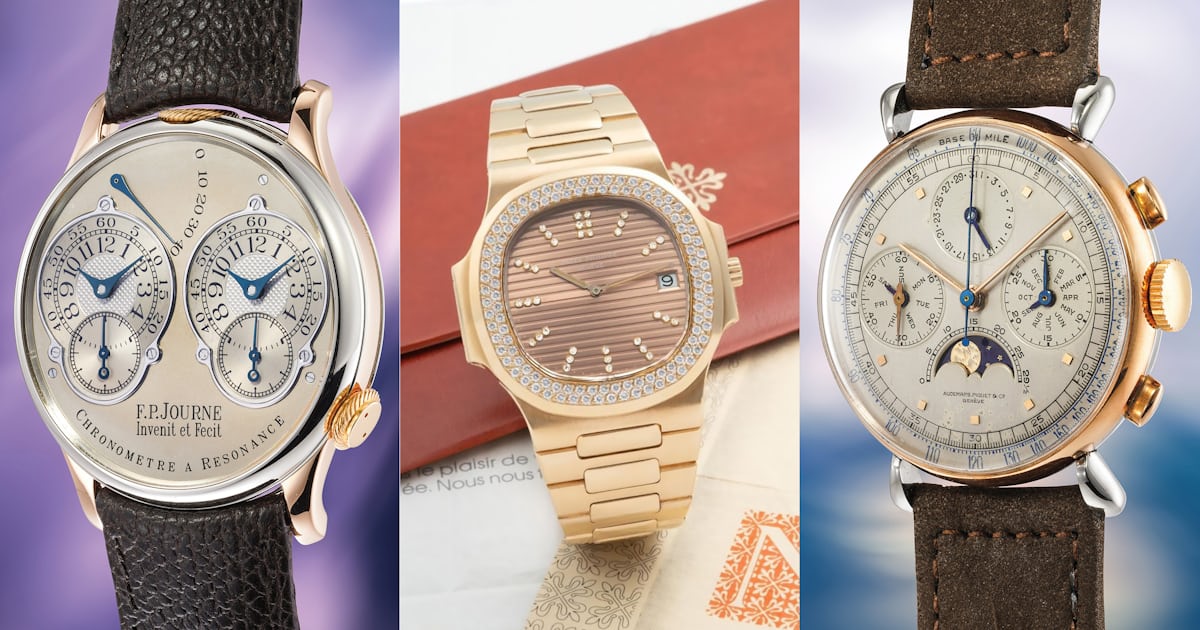
Chronomètre à Résonance “Souscription No. 18” is probably my favorite configuration of souscription Rèsonance, my favorite watch from the brand’s history. There are five such models made with two-tone platinum-and-pink-gold cases; two have a pink-gold dial, and three have a white-gold dial like this one. With a CHF 450,000 to 900,000 estimate, I can see the justification for this performing better than the Rolex 6062 above.
With the same estimate, people seem to really be digging the Chronomètre à Résonance “Pisa” edition (though less rare, with five pieces rather than three), and I can see the argument there, too. And any high-end Journe collector needs brass-movement watches, which predated the gold movements Journe wanted to make (but, at the time, couldn’t afford). The 38mm Tourbillon Souverain à Remontoir d’Egalité with brass movement has an estimate of CHF 350,000 to 700,000. Meanwhile, as a friend reminded me, a Ruthenium Tourbillon isn’t really that rare (there were 99 made, after all), but Phillips has number 98 of 99 up for sale with an estimate of CHF 300,000 to 600,000. The dial has taken on some uneven patina, but maybe someone will find that charming.


But what I’m watching is what it’s done to the rest of the market (also pushed by interest in Dufour, which has waned a bit, Smith, and Rexhep Rexhepi, the past few years) is the general awareness and interest in indie watchmaking. Take, for instance, that Phillips has the first Roger Smith Series 3 to ever come to market. It’s absolutely gorgeous, wears super well on my wrist, and is one of only five pink gold versions made so far.
The estimate is CHF 300,000 to 600,000, and I assume the owner believes the hot market for indies makes it a good time to sell. A tiny step upmarket is the Akrivia AK-06, a watch that collectors falling in love with Rexhep have deemed “the” Akrivia to own (because it’s the simplest and easiest to get, maybe). Bigger and less elegant than a Chronomètre Contemporain, it’s still got amazing finishing, and the estimate is CHF 350,000 to 700,000. Even more expensive is the Naissance d’Une Montre 1 (N°1/11). A collaboration between Greubel Forsey, Philippe Dufour, and Michel Boulanger, this not only inspired the Naissance d’une Montre project but also the Handmade series at GF.

Theo Auffret‘s Giverny Prototype.


Even indies with smaller production or younger workshops are in the mix. To my knowledge, Theo Auffret hasn’t officially delivered production examples of the Giverny model, but there’s a steel prototype for sale. I saw it in person, and while I’m inclined toward Auffret’s tourbillons, this is a very nice three-hand watch made in a traditional style.
There’s a French-meets-English simplicity in the layout, with nice angling and his unusual charbonnage plate-finishing style drawn from his mentor Jean-Baptiste Viot’s Chronomètre à Paris. For two more creative and unusual watches, you can also check out the Ludovic Ballouard X Atelier Blandenier Upside Down “Quel Homard Est Il?” and Lederer Inverto “Prototype 00”.


Last, but certainly not least, my favorite watch of the auction season is the multi-colored stainless steel and 14k pink gold Audemars Piguet triple calendar wristwatch with moonphase, ref. 5503. This is one of only five ever made (of 20 of the movement ever used) and was last sold in 2015 when it entered a very important and prominent collection. I frankly didn’t expect it would ever see the light of day (at least not for sale), but man, if I had all the money in the world, I’d be wearing this watch already. With beautiful teardrop steel lugs, a large, bold dial with pink gold accents, and its rarity, it’s something well worth the CHF 400,000 to 800,000. For another ultra-rare triple-calendar watch, check out this pink-gold Vacheron Constantin Cioccalatone. Yes, it’s less rare (47 examples), but it is still an important watch that hasn’t picked up much traction compared to other brands, and it’s worth watching.
Antiquorum – 672 Lots – May 9 and 10
If you’re looking for deals, Antiquorum is still the place to go. I mean, there are a ton of super weird watches in the auction that pad out the 672-piece catalog. If you want random modern Breitlings, Piagets, cheap Cartiers, Rolexes, or random unsigned pocket watches (some with some gorgeous enamel, to be fair), you can wade through Antiquorum’s catalogs. There are also many really great hidden gems and some big lots.

Photo courtesy Antiquorum.
Everyone has to have a Nautilus or two in their catalog, but the two top lots from Antiquorum are from the model celebrating its 50th anniversary. The first, a unique ref. 3700/13, was ordered through Somazzi in Lugano and is the only one known to have a specially ordered pink dial with three rows of diamonds on each index. The bidding here starts at CHF 1,000,000. While I can imagine it going that high, it’s a pretty aggressive starting point, and you’d better have someone lined up to make that bid. The rare but slightly less exciting Nautilus (though the one I’d wear) is the ref. 5711/1300A-001 in steel with a green dial and diamond bezel. The estimate is CHF 300,000 to 450,000.

Photo courtesy Antiquorum.

Photo courtesy Antiquorum.

Photo courtesy Antiquorum.
But that’s not why people come to an Antiquorum auction. You want the deals. The weird stuff. The stuff that gets buried so you can find it yourself and pick it up for cheap. The stuff where I’m about to blow up your spot (and I’m sorry about that). While it’s not a Gilbert Albert design, how about a Patek Philippe Hour Glass ref. 1593 (yes, it’s got a service dial, but you get a deal because of it and Manta Ray (yes, it’s a bit small, but it’s still kinda fun)? There are a bunch of weird Audemars Piguet in shapes you don’t normally associate with the brand, like not one but two Cioccolatones (a large size in yellow gold with a VZSS movement and a small one in white gold with a K2001 movement) and a rare platinum ref. 5008 “Tank” from the 1950s.

Photo courtesy Antiquorum.

Photo courtesy Antiquorum.

Photo courtesy Antiquorum.
More outlandish? Okay, how about the watch that is reportedly the most complicated watch by Ulysse Nardin, even to this date? Not just a pocket watch, it’s a clock watch (a watch that chimes like a grandfather clock, in short), with Grande, Petite Sonnerie et Silence, a minute-repeater, instantaneous perpetual calendar, and phases of the moon. That’s really cool, and the estimate starts at CHF 30,000, which seems more than fair for an incredible piece of history. For just a bit more, you can bid on a Cartier Jump Hour pocket watch in platinum, the only one known with a band of sapphires around the edge. And while IWC cloisonné watches are never as punchy as some others on the market, there’s a decent example there, too (though I haven’t seen it in person).

Photo courtesy Antiquorum.

Photo courtesy Antiquorum.
You can also get dive watches. Early on, there’s a vintage Blancpain Fifty Fathoms with service hands, but it’s also going to be much cheaper than you could find a correct example from that era. Next up is a Fifty Fathoms 1000 for an even bolder vibe. Did you know Waltham made divers? Not a lot of people remember that. But no one will forget a good Seiko 6159-7000 or 6159-7010 “Tuna.”
Oh, and then there’s the chronographs. I bought a really nice Universal Uni-Compax there in 2024, and a bunch of them sold at bargain prices. There are some chronographs that range far toward the higher end, like a large 37mm black-dialed Rolex ref. 3330 for CHF 70,000 to 120,000 (though on any black dial Rolex chronograph, I need to phone a friend for advice). If you’re wondering why a Patek ref. 1579 in pink gold with a pulsation dial starts at CHF 50,000 because it’s partially reprinted (and even then, it’s got some wear). A great example, sold in 2019 (double-signed), for CHF 162,500.


My recommendation? Hunt the catalog for pieces like this Movado M90 with a roasted-to-salmon pulsation dial and Breguet numerals starting at CHF 8,000 (sorry to Rich Fordon for blowing up your spot, and mine, since I was going to bid). Any collector of affordable chronographs needs a Mido Multi-Centerchrono with a Borgel case, and this one starts at CHF 2,000. Or maybe you can pick up this yellow-gold Eberhard Pre Extra Fort that won’t break the bank but still has great vintage vibes, or do some research on this oversized pilot’s chronograph. The added black dial is in rough shape, and they’re not the rarest watch, but they are cool. It’s watches like this that are where the fun is at for Antiquorum.
Source: www.hodinkee.com — original article published 2026-04-28 13:00:00.
Read the full story on www.hodinkee.com → [source_url]